🧭 Eight Lords, Five Elements, One Sacred Centre: The Wheel of Vastu
Eight directions, each with a ruling energy and an element; a fire corner, a water corner, an earth corner, an air corner; and at the heart of it all, pure space that must be left empty
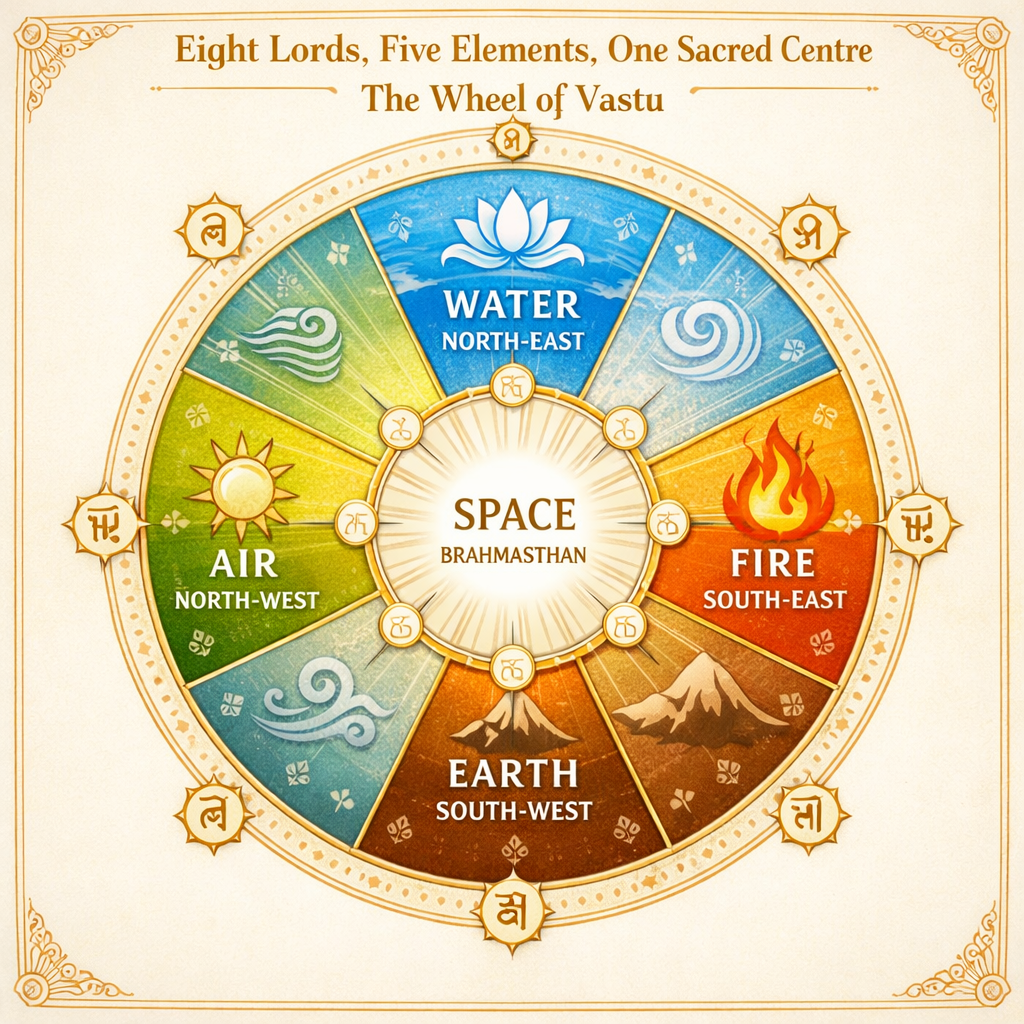
This is the grid most people think is Vastu — and it's the one they get half-right. Eight directions, each with a ruling energy and an element; a fire corner, a water corner, an earth corner, an air corner; and at the heart of it all, pure space that must be left empty. Match a room to its element and it thrives. Set it against its element, and you have a dosha. Simple to state, and the backbone of every practical reading.
Article 5 of the Vastu Diagnostic Grids series.
The master grid, the body, and the vital points are the deep machinery. This is the working dashboard — the wheel a reader consults for nearly every room. It divides the plan into eight directions plus the centre, and assigns each a ruling energy and one of the five elements. A defect, on this wheel, is a function placed in a quarter whose element it contradicts.
🔹 The five elements and where they live
Five elements are distributed around the plan, and this single mapping drives most of what you know as "Vastu rules":
- North-east → Water. The most sacred, luminous quarter. Kept open, light, and clean; the natural home of a water source, a place of calm and worship.
- South-east → Fire. The corner of heat and energy — the natural home of the kitchen, the cooking flame, anything that burns or generates.
- South-west → Earth. The heaviest, most grounding quarter. Kept solid, high, and weighted — the natural anchor of the home and the place of its foundations and its heads.
- North-west → Air. The quarter of movement and circulation — associated with things that come and go.
- Centre → Space. Pure openness, the sacred core, kept empty so the whole plan can breathe.
Learn this five-fold map and most Vastu "rules" stop needing to be memorised — they simply follow. A kitchen belongs in the south-east because fire belongs there. A water tank sits well in the north-east because that is the water quarter. The centre stays clear because it is the element of space itself.
🔹 The eight ruling energies
Overlaid on the elements are eight directional rulers, one per direction, each lending the quarter its temperament — the luminous, opening quality of the north-east; the fierce, consuming quality of the south-east; the grounding, restraining quality of the south-west; the mobile, unsettled quality of the north-west; and so on around the wheel. In practice you read the element for what a room needs and the ruling energy for the flavour of what happens there.
🔹 What a dosha looks like on this wheel
A defect here is an element in conflict with its quarter. The classic clashes:
- Fire in the water quarter — a kitchen, boiler, or heat source in the north-east. Fire fights water in the very corner meant to stay cool and clear.
- Water in the fire or earth quarter — a tank, sump, or wet area in the south-east or south-west, where it dampens the energy those corners are meant to hold.
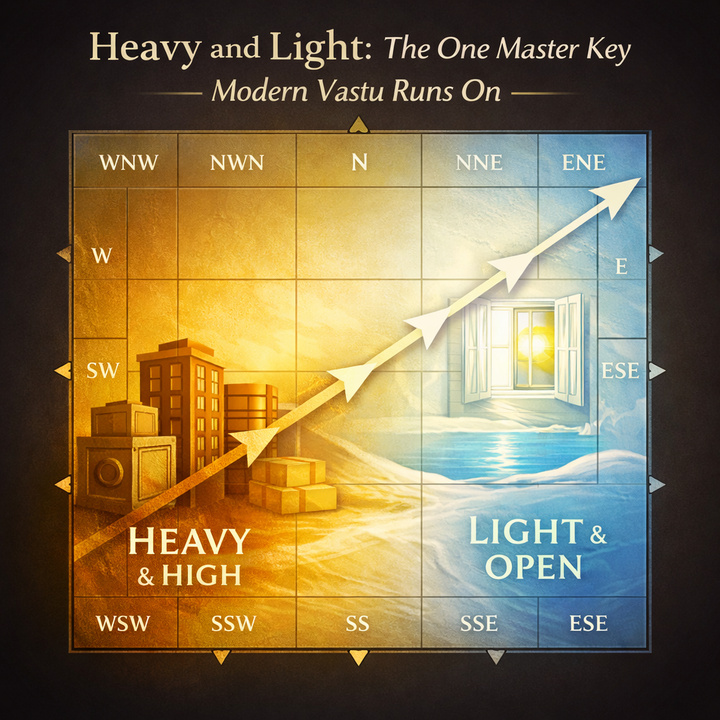
- Weight in the light quarter — heavy storage, tall structure, or a loaded mass in the open north-east.
- Openness in the heavy quarter — a void, a pit, or lightness in the south-west that should be solid and grounded.
- Anything at all on the centre — the space element wants emptiness; a staircase, pillar, toilet, or wet area there is the most common serious fault of all.
🔹 The sacred centre deserves its own line
Of the whole wheel, the centre is the most unforgiving. It is the element of space, the meeting-point of the plan's energy lines, and the heart of the cosmic body all at once. Keep it open, uncovered, and unloaded. A home that keeps its centre clear has already got the single most important thing right.
🔹 How a reader uses it
Laid over an oriented plan, the wheel is read room by room:
- Name each room's element — does it burn, hold water, store weight, or move air?
- Match it to its quarter. Agreement is support; conflict is a dosha.
- Check the centre first. Whatever sits there is weighed most heavily.
- Balance the axis. Light and open toward the north-east; solid and heavy toward the south-west.
Where the ideal placement isn't possible, the correction is to soften the clash — separate fire from water, lighten what's heavy in the north-east, ground what's hollow in the south-west, and above all, clear the centre.
🔹 The takeaway
Eight directions, five elements, one sacred centre — this is the working wheel of Vastu, and the source of nearly every rule you already half-know. Water to the north-east, fire to the south-east, earth to the south-west, air to the north-west, space at the heart. Put each function where its element lives, keep the centre empty, and you have the practical core of the entire discipline in a single map.
Next in the series: the mouth of the house — the thirty-two gates, and how the doorway alone can make or break a reading.
🔹 Keywords & Associations
five elements Vastu, panch tatva, north-east water, south-east fire, south-west earth, north-west air, Brahmasthan space, eight directions, directional lords, Ishaan, Agneya, Nairutya, Vayavya, kitchen direction, water tank direction, sacred centre, Vastu dosha, element clash, directional wheel, home placement.
Comments ()