⚖️ Heavy and Light: The One Master Key Modern Vastu Runs On
Modern Vastu took all of that machinery and compressed it into a single, brutally practical rule: keep the south-west heavy and high, keep the north-east light and open, and let everything fall from one to the other.
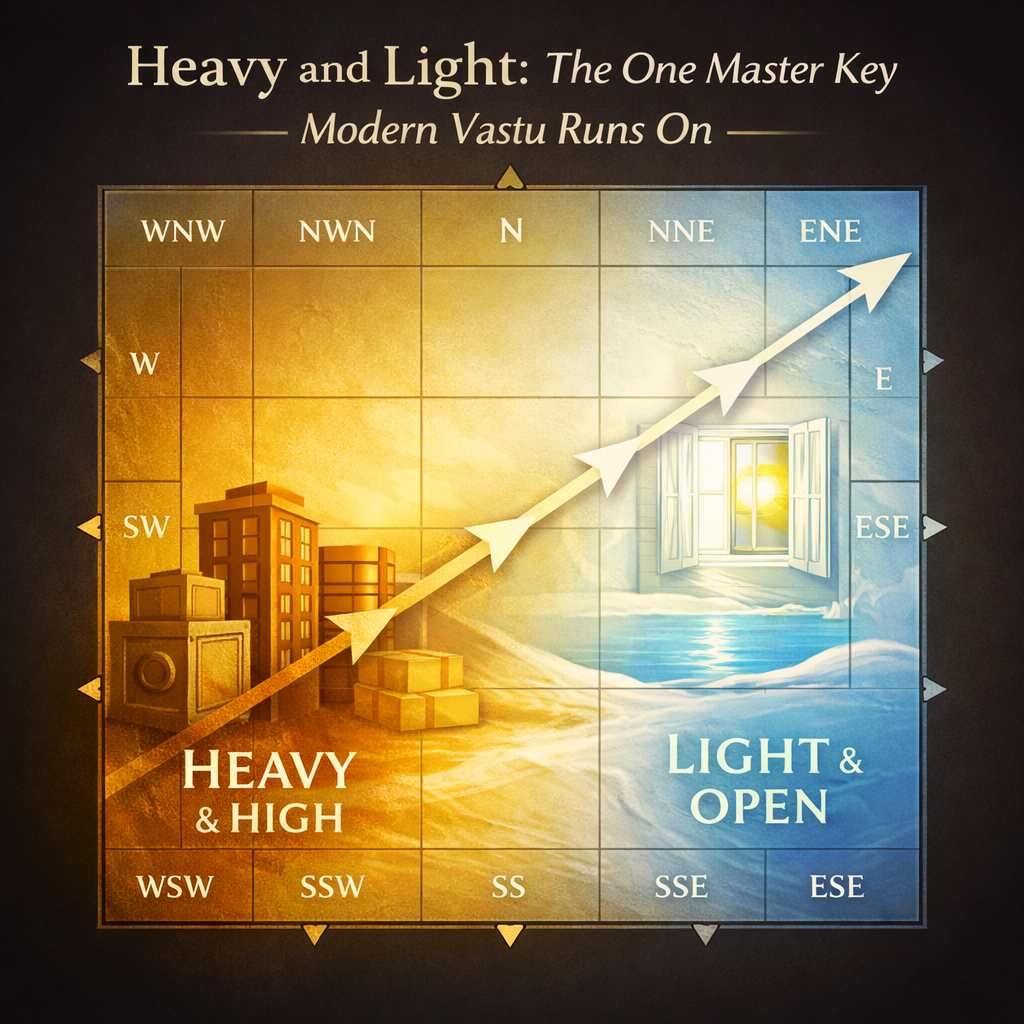
The old system reads a home through deities, a cosmic body, and vital points. Modern Vastu took all of that machinery and compressed it into a single, brutally practical rule: keep the south-west heavy and high, keep the north-east light and open, and let everything fall from one to the other. Learn this one key and you can diagnose most of a home in minutes — because nearly every modern fault is just weight, height, water, or a void, sitting in the wrong quarter.
Article 9 of the Vastu Diagnostic Grids series.
We now cross from the classical grids into the modern approach. Contemporary practice kept the same directions and the same conclusions, but replaced the deity-language with a physics-flavoured one — flow, load, balance — and boiled the whole thing down to one governing principle. It is the most useful single idea in practical Vastu, and it powers almost every modern rule.
🔹 The master key
The rule has three parts, and they always move together:
- The south-west (and the south and west) should be heavy, high, solid, and built-up. This is the anchor of the home — thick walls, tall structure, weight, storage, the master retreat.
- The north-east (and the north and east) should be light, low, open, and clear. This is the intake — glass, gaps, water, low walls, empty space.
- The ground should fall from the heavy corner to the light one — highest at the south-west, lowest at the north-east, with the slope of floors, roofs, and land all running that way.
Picture the home as a vessel tilted to catch light and air in one corner and ballasted to stay stable in the other. That single image explains a startling amount of Vastu at once.
🔹 The sixteen-zone refinement
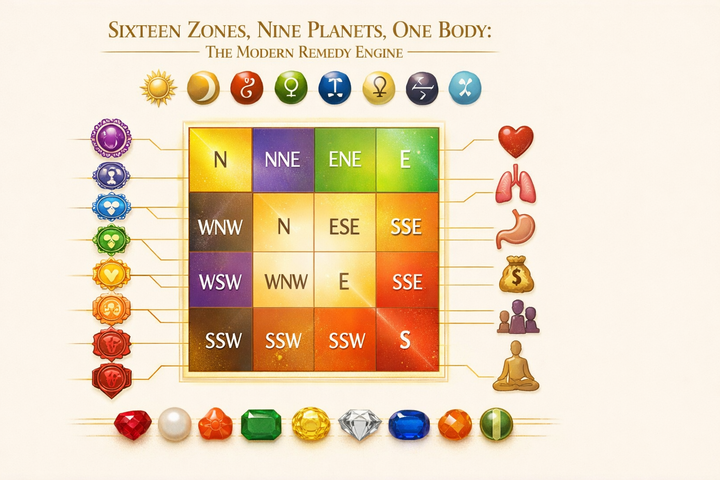
Modern practice also splits the eight directions into sixteen finer zones — the half-sectors between each cardinal and its neighbouring corner (north-north-east, east-north-east, and so on). This lets a reader be precise about exactly where in a quarter a feature sits, rather than treating a whole side as one block. A defect that would be vague as "something wrong in the north" becomes specific: which sixteenth of the plan carries it, and therefore how to read it. The heavy-light key still governs; the sixteen zones just sharpen the aim.
🔹 What a dosha looks like under this key
Once you hold the master key, faults almost announce themselves. A defect is anything that inverts the intended balance:
- Heaviness in the light corner — a tall structure, a heavy store, a loaded mass, or an overhead tank pressing down on the north-east.
- A void in the heavy corner — a pit, a hollow, an underground tank, or lightness in the south-west that should be solid.
- Water in the wrong place — a well or sump toward the south-west (the heavy, dry anchor) instead of the north-east; or an overhead tank in the north-east instead of the heavy side.
- The slope running backwards — ground or drainage falling toward the south-west instead of the north-east.
- The centre loaded — the one place both systems agree must stay open, weighed down by a stair, a pillar, or a wet area.
Every one of these is the same fault in a different costume: mass and openness in the wrong quarters.
🔹 Why it works as a diagnostic
The power of the master key is speed and consistency. You don't need to trace deities or vital points to get a first, reliable read on a home — you look at where the weight is, where the openness is, and which way the ground falls. If the heavy things cluster to the south-west and the open, watery, glassy things to the north-east, the home is fundamentally sound and you're only tuning details. If it's inverted — a heavy south-west turned hollow, a light north-east turned solid — you've found the core problem before you've looked at a single room's function.
🔹 How a reader uses it
On an oriented plan:
- Map the weight. Where are the tall, heavy, built-up masses? They should gather to the south-west.
- Map the openness. Where are the gaps, glass, water, and low ground? They should gather to the north-east.
- Check the slope. Floors, roof, and land should fall south-west to north-east.
- Zoom to the sixteen zones for anything that needs a precise call.
- Correct by rebalancing, cheapest first — shift weight toward the heavy corner, open up the light one, re-route water and slope — long before anything structural.
🔹 The takeaway
Modern Vastu runs on one master key: heavy and high to the south-west, light and open to the north-east, ground falling between them. Split into sixteen zones for precision, it lets you diagnose most of a home at a glance, because nearly every modern dosha is simply mass or openness in the wrong quarter. Get the balance right and the details mostly fall into line; get it inverted and no amount of detail will save the reading.
Next in the series: how modern Vastu turns a located fault into a named cure — the remedy engine of planets, chakras, and colours.
🔹 Keywords & Associations
heavy and light Vastu, south-west heavy, north-east light, slope Vastu, weight balance, sixteen zones, sub-directions, energy flow, overhead tank, underground tank, void Vastu, master key, modern Vastu, Vastu dosha, home diagnosis, floor plan analysis, directional weight, open north-east, sacred centre.
Comments ()