Will You Be Free of Debt? What Your Horoscope Reveals About Loans, Repayment, and Financial Freedom
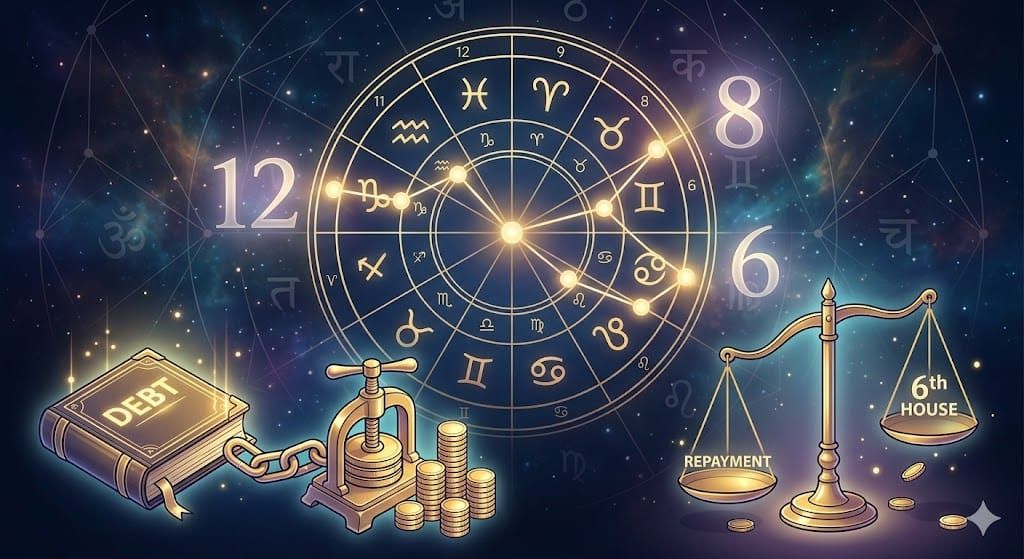
6th house is the gateway to debt. By analyzing the Cuspal Sub-Lord, we reveal your financial destiny—from manageable loans to debt traps—and use the 12th house and Dasa-Bukthi to predict the exact timing of repayment
Introduction
Debt is one of the most common and emotionally charged topics in astrological consultation. Whether someone is worried about a mounting home loan, wondering if a business debt will be repaid, or curious about their overall financial destiny with respect to borrowing — the horoscope holds clear answers.
In KP Stellar Astrology — specifically the Cuspal Interlinks Theory (CILT) — every life area is governed by a specific house (called a bhava). The destiny or potential of that life area is determined by the Cuspal Sub-Lord (CSL) of that house. The CSL is the planet that governs the precise degree of a house cusp, and the houses it is connected with through its star lord and sub lord reveal whether that life area will flourish, stagnate, or face challenges.
For debt and loan matters, the 6th house is the primary house. But the story doesn't end there. The specific houses connected with the 6th CSL paint a much richer picture — telling us not just whether debt will come, but what kind of debt it will be, how long it will last, and whether it will resolve easily or trap the native.
The 6th House: Hero of All Debt Matters
In CILT, the 6th house is the seat of debt, loans, disease, and employment. When we analyse debt, the 6th Cuspal Sub-Lord is our starting point. The houses that this CSL is connected with — through its star lord and sub lord chain — determine the potential or destiny of the native's relationship with debt.
A fundamental principle to understand first: the 6th house is not unfavourable to the Ascendant (Lagna). Unlike the 8th and 12th houses, which directly oppose the native's wellbeing, the 6th house by itself does not cause harm. If the 6th CSL is connected only with 6 (and not with 8 or 12), the native will have loans — but will also have the capacity to repay them comfortably.
Key Principle: The 6th house represents getting debt. The 12th house represents the settlement of debt. Together they form the complete cycle of borrowing and repaying.
The Complete Spectrum: From No Debt to Debt Trap
The houses connected with the 6th CSL create a spectrum of outcomes. Let us explore each scenario systematically.
6th CSL Connected with 5th House — Debt Destroyed at Source
The 5th house is the 12th position counted from the 6th house. In CILT, the 12th from any house represents the destruction or negation of that house's significations. When the 6th CSL is connected with the 5th house, the debt potential is destroyed before it even fully forms.
The result: the native will find it very difficult to accumulate any significant debt. Even if a loan is taken for practical reasons, it gets settled as early as possible. The 5th house also happens to be favourable to the Lagna (it is an odd-numbered house), so the native experiences happiness and no mental disturbance around financial matters.
In one documented case, a native with this configuration hesitated to borrow even small amounts. When a motorcycle was purchased through a bank loan at low interest, the entire amount was settled within just eight months.
6th CSL Connected with 11th House — Debt Potential Weakened
The 11th house is the 6th position counted from the 6th house — making it part of the same trigona group (6, 10, 2 cycle). When the 6th CSL is connected with 11, we must carefully assess the effect.
The 11th house is an odd-numbered house and is favourable to the Lagna. This means the native will not suffer mentally from any loan situation. However, the 11th house as the 6th from 6th can also indicate a renewal or recurrence of the debt theme — loans may come, but they come without causing distress.
The native experiences satisfaction and contentment even during periods of borrowing. The 11th house is the house of fulfilment and gains, so any debt taken during such a period tends to serve a productive purpose and the native maintains the upper hand over the loan.
Important Distinction: Do not confuse "6th connected with 5" and "6th connected with 11." The 5th house directly destroys the 6th (being 12th from 6th), leading to rapid settlement. The 11th house weakens the distress but does not necessarily destroy the loan itself.
6th CSL Connected with 4th House — Long-Term, Enduring Debt
This is where the picture changes significantly. The 4th house is the 11th position counted from the 6th house. In CILT, the 11th from any house is the house of full activation and satisfaction of that house's significations. The 11th house destroys the 12th house of any bhava, thereby removing the factor that would normally limit or end it.
When the 6th CSL is connected with the 4th house, the debt potential is fully activated. The loan continues for a long period, sustains itself, and is difficult to close out quickly. This is the classic signature of a long-term loan — think home mortgages, long-tenure business loans, or debts that persist across decades.
This interpretation is further reinforced by the general nature of the 4th house itself. In CILT, the 4th house represents permanence, stability, and things that stay with you for a long time. Whether it is property, vehicles, or in this case debt — what the 4th house touches tends to be long-lasting.
6th CSL Connected with 8th House — Heavy and Escalated Debt
The 8th house is the 3rd position from the 6th house. In CILT, the 3rd from any house is the upgrading or escalation house — it takes the previous house's signification and multiplies it. Just as the 4th house is a "bundle of money" compared to the 2nd house's single note, the 8th house is the upgraded, intensified version of the 6th house.
This is explicitly taught: the 6th house is a loan; the 8th house is a heavy loan. Where the 6th house represents a manageable, single debt, the 8th house represents multiple debts, compounding interest, unexpected financial burdens, and loans that spiral beyond the native's original intention.
Furthermore, the 8th house is unfavourable to the Lagna. This means the native not only carries heavy debt but also loses personal vitality, confidence, and wellbeing because of it. The debt becomes a source of deep worry and psychological burden.
6th CSL Connected with 8 and 12 — The Debt Trap
When the 6th CSL is connected with both the 8th and 12th houses, the situation reaches its worst form. The repaying capacity of the native is severely reduced. The 8th house escalates the debt while the 12th house — being unfavourable to the Lagna — drains the native's resources and energy.
This is the configuration that creates what we commonly call a "debt trap" — a cycle where the native borrows to repay, borrows again, and finds no exit. The native's self-respect, health, and peace of mind are all compromised.
6th CSL Connected with 2, 4, 6, 10 — Manageable, Productive Debt
When the 6th CSL is connected with even-numbered houses in the material trigona group (2, 4, 6, 10), the loan potential is strong but manageable. The native will take loans — but these loans serve productive purposes and the native has the repaying capacity.
The 6th house alone (without 8 or 12 involvement) means the native can handle the debt. The 2nd house provides liquid cash, the 4th provides assets as security, and the 10th provides steady professional income to service the debt. This is the configuration of a responsible borrower — someone who uses debt as a financial tool rather than falling victim to it.
Quick Reference: 6th CSL Connections and Their Effects
| 6th CSL Connected With | Counted From 6th | Effect on Debt |
|---|---|---|
| 5th house | 12th from 6th | Debt destroyed at source. Loans settle very quickly. Native avoids borrowing. |
| 1, 3, 9 (odd houses) | Favourable to Lagna | Debt potential is weak. Native is happy and unburdened by loans. Minimal borrowing. |
| 11th house | 6th from 6th | Debt comes without distress. Native maintains control. Productive borrowing. |
| 2, 6, 10 | Material trigona | Loans are manageable. Strong repaying capacity. Debt serves productive purpose. |
| 4th house | 11th from 6th | Long-term debt. Loan fully activates and continues for extended periods (e.g., mortgage). |
| 8th house | 3rd from 6th | Heavy loan. Multiple debts. Escalated burden. Unfavourable to Lagna — causes worry. |
| 8 and 12 | Unfavourable to Lagna | Debt trap. Repaying capacity destroyed. Cycle of borrowing with no exit. |
The 12th House: Settlement of Debt
While the 6th house governs the entry of debt, the 12th house governs its settlement and exit. This is a core principle: the 6th house is getting the debt, and the 12th house is the settlement of debt.
An interesting case arises when the same planet serves as the CSL of both the 6th and 12th houses. In such cases, whatever debt comes into the native's life through the 6th house will have a matching settlement mechanism through the 12th house — creating a self-balancing effect where loans come and go without creating lasting damage.
Another related concept: the 11th house represents the receipt of money with interest that was previously lent to another person. In other words, if the native is the lender rather than the borrower, the 11th house governs the return of that money with interest. The 7th house indicates the person who received the loan from the native.
When Will Debt Come and Go? The Role of Dasa-Bukthi
The 6th CSL tells us the potential — the overall destiny regarding debt. But the timing of when loans actually manifest or get settled depends on the running planetary periods, known as Dasa-Bukthi.
The principle is straightforward: when the Dasa lord or Bukthi lord is connected with houses that are favourable to the 6th house (that is, they activate the 6th house), the native will encounter debt during that period. When the Dasa lord or Bukthi lord is connected with houses that weaken the 6th house (especially the 5th house, which is the 12th from the 6th), loans get settled during that period.
For example, if a native's Mars and Saturn periods are connected with houses favourable to the 6th house, those periods may bring loans. But Mercury and Jupiter periods connected with the 5th house will trigger settlement of those debts. The debt comes and goes in rhythm with the planetary periods.
Practical Tip: Even a native with a weak 6th potential (minimal debt destiny) may encounter temporary loan situations during specific Dasa-Bukthi periods that activate the 6th house. Similarly, a native with strong 6th potential will find relief during periods that weaken or negate the 6th house.
Short-Term vs Long-Term: The 3rd and 4th House Principle
A powerful parallel exists in CILT between debt duration and the general principle governing all possessions. In the theory, the 3rd house represents things that are temporary, short-lived, and easily replaced — the "use and throw" category. The 4th house represents things that are permanent, lasting, and stay with you for life.
This same principle applies to loans. When the debt-related period (Dasa-Bukthi or Antara) is connected with the 3rd house, the loan will be short-term — taken and repaid quickly. When connected with the 4th house, the loan endures for a long time. This is consistent with the 4th house being the 11th from the 6th (full activation of debt).
Consider a practical example: someone takes a personal loan during a Bukthi period connected with the 3rd house — they may repay it within months. The same person takes a home loan during a Bukthi connected with the 4th house — that mortgage may run for 20 or 30 years.
The Escalation Principle: From Loan to Heavy Loan
One of the most elegant principles in CILT is the 3rd house upgrading rule. Every 3rd house from any bhava takes that bhava's signification and multiplies it. This creates a clear hierarchy for debt:
| House | Debt Level | Analogy |
|---|---|---|
| 6th house | Basic loan — single, curable, manageable | A single banknote of ₹2,000 |
| 8th house | Heavy loan — multiple, escalated, burdensome | A bundle of notes — ₹2,00,000 |
| 10th house | Massive, institutional-level debt | Corporate or sovereign-level borrowing |
This escalation is directly parallel to how the theory treats land: the 4th house is a small plot of 1,000–3,000 square feet, while the 6th house represents agricultural land measured in acres. Each 3rd house multiplies the previous.
The Lagna Factor: Will Debt Cause Suffering?
A critical distinction in CILT: a house being active (strong potential) does not automatically mean the native will suffer. The suffering depends on whether the configuration is also unfavourable to the Lagna.
The 6th house connected with odd numbers (1, 3, 5, 7, 9, 11) means the debt potential is weak and favourable to the Lagna. The native either avoids debt altogether or handles it with happiness and ease. The 6th house connected with the 8th and 12th means not only is the debt heavy, but the native's wellbeing is directly harmed — loss of energy, self-respect, and peace.
The 6th connected only with the 6th (without 8 or 12) is a middle ground: the loan exists, but the native has repaying capacity and the debt does not damage their life.
Critical Rule: Only 6th alone is not damaging to the native. If 8 and 12 join, the repaying capacity is reduced and real problems begin. Always check whether 8 or 12 accompanies the 6th house connection.


Comments ()