The Four-Pillar Framework: Measuring Potential for Any Life Event
Part 5 of the series: "The Twin Engines of a Horoscope — How Houses and Planets Work Together in Astrology"
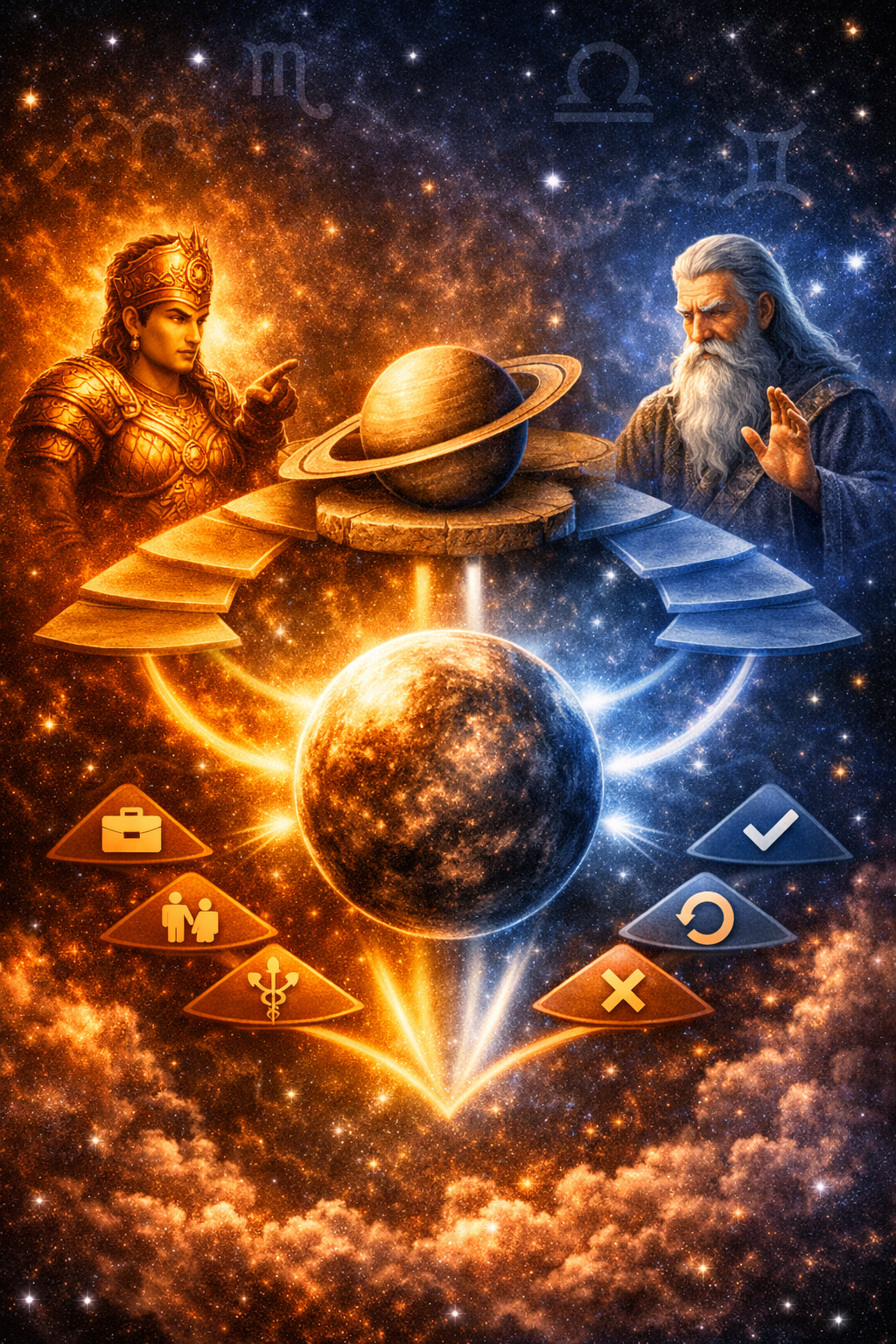
The first four articles built the vocabulary. Houses speak through inner and outer karakas. Planets speak through inner and outer karakas. The Star Lord and Sub Lord system transforms every planet from a static symbol into a dynamic actor that connects with specific houses. You now understand the language.
This article introduces the measuring instrument.
When someone asks "Will I get married?" or "How is my career?" or "Will I have children?" — the answer is not a binary yes or no. It is a measurement — a score built from four separate pillars, each contributing a defined share to the total potential. This framework is the practical engine that turns the theory of the previous articles into actionable prediction.
Why Potential Matters More Than Anything Else
Before we look at the four pillars, an important context. In astrology, three forces shape every life event:
Potential (Fate) is by far the dominant force. This is the permanent, static quality of the event — encoded at birth through the cuspal positions. It determines HOW the event will unfold. Will the marriage be happy or troubled? Will the career be prestigious or stagnant? Will the children be supportive or distant? Potential answers these questions, and it never changes throughout life.
Dasa-Bhukti is the second force — significant but subordinate. This is the timing mechanism — it determines WHEN the event will manifest. A strong dasa period can temporarily protect a weak potential; a weak dasa period can temporarily disturb a strong potential. But it cannot fundamentally alter the fate encoded in the potential. The dasa is the chisel; the potential is the rock.
Transit is the smallest force. This is the fine-tuning — current planetary positions that create short-term fluctuations. Transits are the weather; potential is the climate.
The four-pillar framework measures the potential — the dominant force. It tells you not just whether an event will happen, but what quality it will carry when it does.
The Four Pillars
For any life event — marriage, career, health, children, property, foreign travel — the total potential is evaluated across four pillars. Each carries a defined weight, and together they form the complete picture.
Pillar 1: Bhava Karaka — the largest share, alongside Graha Karaka
This is the relevant house for the matter in question. For marriage, it is the 7th house. For career, the 10th house. For children, the 5th house. For money, the 2nd house.
You evaluate the house by checking its Cuspal Sub Lord (CSL) — the planet governing the sub-division of that house's cusp. You then trace the CSL's Star Lord and Sub Lord connections. If those connections run through houses favorable to the matter, the bhava potential is strong. If they run through unfavorable houses — the bhava potential is weak.
This pillar answers the fundamental question: does the building exist? Is the structural framework for this event present in the horoscope? A strong 7th house means the architecture for marriage is solid. A weak 7th house means the architecture is cracked — regardless of everything else.
Pillar 2: Graha Karaka — equal in weight to the Bhava Karaka
This is the natural significator planet for the matter. For marriage in a male horoscope, it is Venus (the Kalatra Karaka — spouse significator). For marriage in a female horoscope, it is Mars. For children, Jupiter. For career, Sun (government and top rank) and Saturn (lower-level and structured jobs). For health, Sun carries the dominant share, Moon carries a substantial secondary share, and Ketu carries a smaller but important share — together forming the complete health graha karaka assessment.
You evaluate the graha karaka the same way you evaluate a CSL — by tracing its Star Lord and Sub Lord connections. If Venus (for a male horoscope) connects with houses favorable to the 7th, the intimate and emotional dimension of marriage is protected. If Venus connects with unfavorable houses, the private life suffers even if the public marriage (7th house) appears intact.
This pillar answers a different question: is the paint available? The building may exist, but does the planet that naturally governs the matter carry favorable connections? A beautiful building with peeling paint is a functional but joyless marriage. Paint without a building is potential without manifestation.
Pillar 3: Lagna — a meaningful but smaller share
Lagna is the native — the brain of the horoscope. It controls all 12 houses the way a Prime Minister oversees all ministries. Each bhava is like an individual minister — the Railway Minister has more operational power in railway matters than the Prime Minister, but the Prime Minister can still intervene in railway projects.
You evaluate the Lagna Sub Lord's connections. If the Lagna connects with houses favorable to the matter in question, the native can personally enjoy the results. If the Lagna connects with unfavorable houses, the native's ability to experience the event is limited — even if the bhava and graha karaka are both strong.
This pillar answers: can the native enjoy it? A person with a strong 7th house and strong Venus but a weak Lagna may technically be married but feel emotionally disconnected from the experience. The event exists, but the experiencer is absent.
Pillar 4: 9th House (Bhagya) — the smallest share
The 9th house is the house of fortune — God's grace, luck, the invisible hand that tips the scales. It represents previous birth karma carried forward, hereditary blessings, and the proactive sense that helps the native detect opportunity or danger before it arrives.
You check the 9th house Sub Lord's connections. A favorable 9th house can elevate a good result to an excellent one. An unfavorable 9th house withholds that grace — the native must achieve everything through effort alone.
This pillar answers: is divine grace available? It is the smallest contributor, but in borderline cases — where the other three pillars are mediocre — this final sliver of fortune can be the difference between an event barely manifesting and an event not happening at all.
The Critical Rule: Why Both Must Be Checked
Bhava Karaka and Graha Karaka together account for the overwhelming majority of the potential. This is the structural heart of the framework. And it generates a critical rule:
If BOTH the bhava and the graha karaka are weak, the matter is severely compromised. Marriage will either not happen or will not sustain. Career will stagnate. Children will be delayed or denied. The building has no paint and the foundation is cracked.
If at least ONE of them is strong, the matter can sustain. The strong pillar compensates for the weak one. If the 7th house is weak but Venus is strong, the public marriage may face challenges but the intimate life provides emotional sustenance. If Venus is weak but the 7th house is strong, the structural marriage holds even though the emotional depth is limited.
If BOTH are strong, the matter flourishes. This is the ideal — a solid building with beautiful paint. The event manifests fully, sustains well, and brings satisfaction to the native.
This rule prevents two common errors in practice. Checking only the house and ignoring the graha karaka gives you half the picture. Checking only the planet and ignoring the house gives you the other half. Neither half alone is reliable. The twin engines must be read as a whole.
Worked Example: Marriage Analysis
Let's walk through a complete four-pillar assessment for marriage in a male horoscope.
Pillar 1 — 7th House: You identify the 7th CSL and trace its Star Lord and Sub Lord. Suppose the CSL's connections include the 2nd house (family, money — favorable to the 7th), the 5th house (love, romance — very favorable), and the 11th house (fulfillment of desire — the most favorable). This is a strong bhava potential. The building is solid.
Now suppose instead the CSL connects with the 6th house (disputes, litigation) and the 12th house (separation, loss). This is a weak bhava potential. The building is cracked. Marriage will face structural problems regardless of other factors.
Pillar 2 — Venus: You trace Venus's Star Lord and Sub Lord connections. Venus should ideally connect with odd-numbered houses — particularly 1, 3, 5, 7, 9, 11. These support the emotional, intimate, and relational dimension of marriage. Venus connected with neutral or material houses provides support without emotional depth. Venus connected with unfavorable houses damages the bedroom life and intimate connection. And there is a specific warning: Venus connected with 5 and 9 simultaneously can indicate a person with excessive romantic desire — potentially leading to extramarital attractions. The 5th and 9th, being evolutionary trikonas of the Lagna, amplify desire beyond what a single partnership can contain.
Pillar 3 — Lagna: The Lagna Sub Lord's connections are checked for favorability to the 7th house. Lagna connected with odd numbers means the native can enjoy marriage. Lagna connected with unfavorable houses means the native's ability to experience marital happiness is limited.
Pillar 4 — 9th House: The 9th Sub Lord is checked. Favorable connections mean divine grace supports the marriage. Unfavorable connections mean the native must work harder for marital satisfaction.
Now the synthesis. If all four pillars score well, marriage will be excellent — happy, sustained, emotionally rich, and financially supported. If the 7th house is strong but Venus is weak, the marriage survives but the intimate life struggles. If Venus is strong but the 7th house is damaged, the native has romantic capacity but the marriage structure cannot hold. If Lagna is weak, the native cannot fully enjoy even a structurally sound and emotionally available marriage.
The Potential Is Fixed; The Timing Is Not
A critical concept: the potential is permanently encoded at birth. It does not change with time, with remedies, or with effort. What changes is the timing of when that potential activates — and that is governed by the Dasa-Bhukti system.
Think of potential as the rock and the Dasa-Bhukti as the chisel.
If the rock is tight and high-quality (strong potential), a chisel (bad dasa period) can only leave a dot mark — a temporary disturbance. The wife goes to her father's house for a week and then returns. The career faces a brief setback and recovers.
If the rock is made of sand (weak potential), the same chisel shatters it completely — permanent damage. The wife goes to her father's house and doesn't return. The career collapses without recovery.
This is why potential assessment must come first. Before you look at dasa periods, before you check transits, before you time events — you must know the quality of the rock. A strong potential can absorb bad dasa periods. A weak potential cannot survive them.
The Dasa Lord Protection Mechanism
There is a powerful interaction between permanent potential and running dasa periods that deserves specific attention.
When the bhava potential is weak — say the 7th house connects with unfavorable houses — the matter is structurally damaged. But if the running Dasa Lord connects with houses that directly oppose those negative houses, the Dasa Lord temporarily protects the bhava. During that dasa period, the weak potential is held at bay. The marriage survives, the career continues, the health maintains.
But when the dasa changes to a lord that also connects with unfavorable houses, the protection drops. The weak potential activates with full force. The problems that were suppressed during the favorable dasa now manifest — sometimes suddenly, sometimes with accumulated intensity.
This is why the same bhava can produce entirely different experiences across different dasa periods, even though the potential never changed. The rock was always sand. The favorable dasa was simply keeping the chisel away.
The practical rule: if potential is bad AND dasa is bad, problems intensify. If potential is bad AND dasa is good, problems are temporarily held at bay. The protection is real but temporary. The potential is permanent.
Applying the Framework Beyond Marriage
The four-pillar framework applies identically to every life area. The only thing that changes is which house and which planet you plug into the first two pillars.
For career: Bhava Karaka is the 10th house CSL. Graha Karaka is Sun for government and leadership roles, Saturn for structured and labor-intensive roles. Lagna and 9th house complete the picture.
For children: Bhava Karaka is the 5th house CSL. Graha Karaka is Jupiter. Lagna and 9th house complete the picture.
For health: The framework adapts. The bhava karaka weight is distributed across four houses — Lagna carries the largest share (immunity), the 6th house carries the next (disease and medicine), the 8th house carries a moderate share (danger and surgery), and the 12th house carries the smallest share (hospitalization and organ loss). Graha Karaka for health uses a specific priority hierarchy — Sun is the most critical, Moon is the second most important, and Ketu rounds out the assessment. If these three planets plus the four critical houses are all favorable, diseases from other planets manifest only after the body's natural warranty period ends.
For property: Bhava Karaka is the 4th house CSL. Graha Karaka is Saturn for land, Venus for luxury property, Moon for water-facing property. Lagna and 9th house complete the picture.
The framework is universal. The inputs are specific. Once you internalize the four-pillar structure, you can evaluate any life question by identifying the correct bhava and graha karaka and running the same assessment.
What the Framework Does Not Tell You
The four pillars measure potential — the quality and strength of the event. They do not tell you three things:
When it will happen. Timing requires Dasa-Bhukti analysis — which planet's period is running and whether that period activates the relevant houses.
Which specific karaka will activate. The 7th house has dozens of significations — marriage, business partnership, public dealings, physical intimacy, and many more. The four-pillar score tells you the 7th house is strong or weak, but which specific karaka manifests depends on the inner/outer activation rules covered in the next article.
What the trade-offs will be. Every activation comes with a negation. A strong 7th house that activates marriage also affects the houses that are 8th and 12th from the 7th. The four-pillar framework gives you the net score but doesn't itemize the gains and losses — that requires the trikona analysis covered in Article 7.
The framework is the foundation. The deeper mechanics build on it.
What Comes Next
Next in this series: Article 6 — "Which Karaka Wakes Up? The Activation Rules for Inner and Outer Results"
If you missed it: Article 4 — "How Planets Change Their Nature: The Star Lord and Sub Lord Transformation"
This article is part of an educational series on astrology concepts. No real horoscope data has been used. All examples are illustrative.

Comments ()