Rahu vs Ketu — The Diametric Pair and Mundane Astrology
Article 9 of the Rahu Series in Astrology
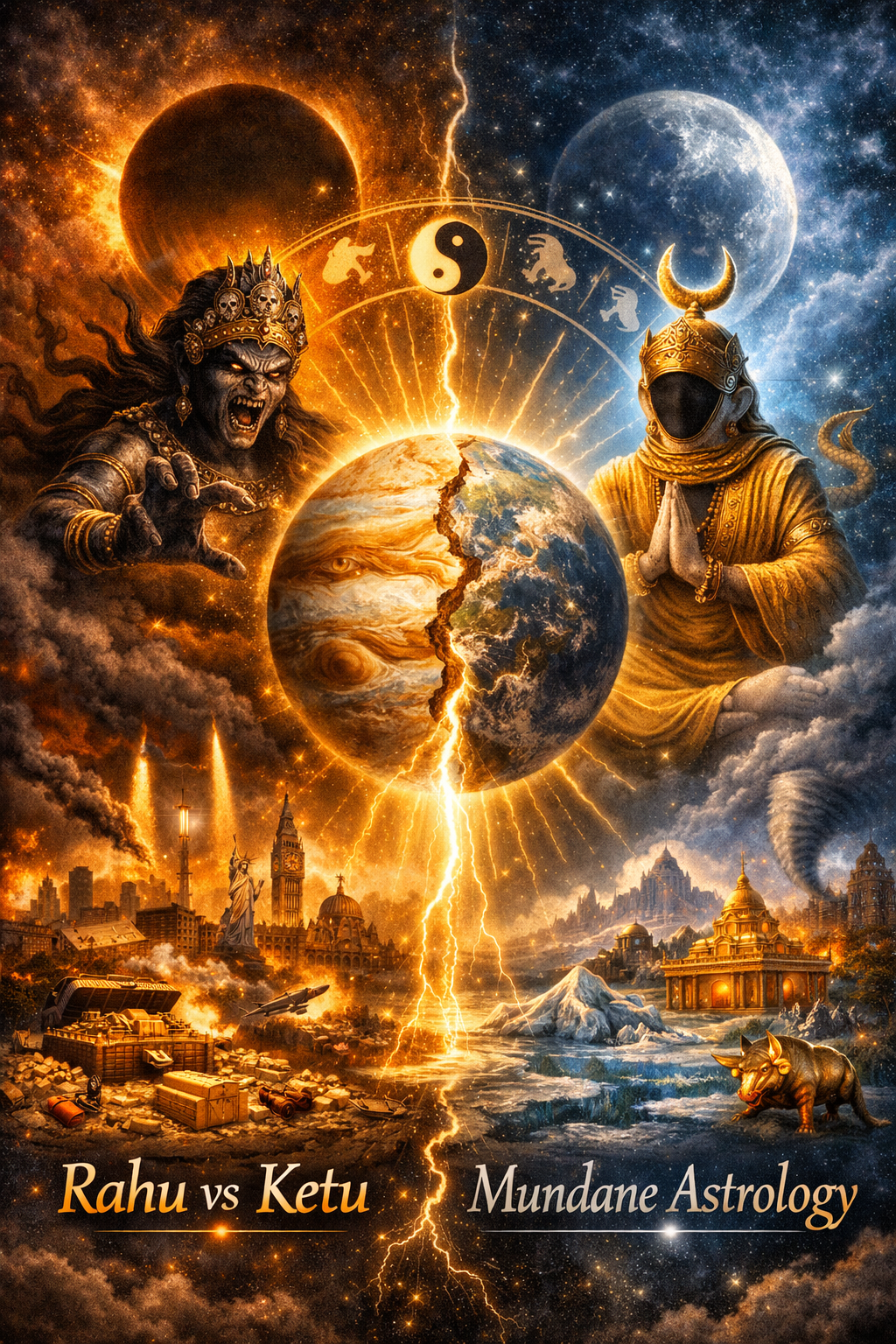
The two shadow planets always sit 180° apart in the zodiac. They are the north and south nodes of the Moon's orbit, mathematical opposites by definition. They share the artificial nature, the absence of physical body, the status of imaginary points calculated rather than observed. But within these similarities, they operate as exact opposites in their effects.
Rahu expands. Ketu contracts. Rahu makes things huge. Ketu makes things small. Rahu shows everything outwardly. Ketu hides everything secretly. The pair forms one of the most elegant diametric relationships in astrology, and understanding both planets together reveals more than studying either alone.
This article completes Rahu's picture by examining the contrast with Ketu in detail, then turns to where the Rahu-Ketu axis matters most beyond individual chart work — mundane astrology and mass-event analysis, where the shadow planets' periods coincide with the largest-scale historical patterns.
The Diametric Foundation
Rahu and Ketu are derived from the same astronomical phenomenon: the intersections of the Moon's orbital plane with the apparent path of the Sun (the ecliptic). The orbit crosses the ecliptic at two points, exactly 180° apart. The ascending node — where the Moon moves northward across the ecliptic — is Rahu. The descending node — where the Moon moves southward — is Ketu.
Eclipses occur exactly when the Sun, Moon, and one of the nodes align. This is why the nodes were named for the demon Rahu in mythology, who was said to swallow the Sun and Moon during eclipses. The astronomical reality is structural; the symbolic interpretation grew from it.
The 180° separation matters in chart analysis. Rahu and Ketu always sit in opposite houses. If Rahu is in the 3rd, Ketu is in the 9th. If Rahu is in the 7th, Ketu is in the 1st. They form an axis through the chart, not a single point.
This axis-nature is part of why their effects are described as opposite rather than complementary. They mark the artificial dimension at both extremes — the outward-expanding pole (Rahu) and the inward-contracting pole (Ketu). A chart engages the artificial axis through both ends simultaneously.
The Comparison Table
| Aspect | Rahu | Ketu |
|---|---|---|
| Symbol | Head of snake | Tail of snake |
| Operation | Expand, make huge | Shrink, make small |
| Saturn/Mars Agent | Agent of Saturn | Agent of Mars |
| Dasa Period | 18 years | 7 years (same as Mars) |
| Gender | Female | Male |
| Deity | Durga | Lord Vinayaga |
| Colour | Grey | Deep red |
| Direction | South West | North West |
| Taste | Sour | Umami |
| Foods | Bengal gram | Horse gram |
| Body Parts | Lungs, breathing, abnormal growths | Acids in body, small intestine, big intestine, chemical reactions |
| Cancer Type | Localised (85% of cases), tumour at one organ | Spread (15% of cases), blood cancer all over body |
| Show / Hide | Show outside (visible) | Keep secret inside |
| Action Mode | Grand manner | Substantial / quiet manner |
| Disease Pattern | Boost anything (huge growth) | Destroy anything (deformation) |
| Diagnosis | Easy to identify (visible change) | Late diagnosis (undiagnosed / secret) |
| Death Karaka | Multiple deaths (mass accidents) | Riots, partitions, conspiracy, secret violence |
| Profession Domain | Foreign, aerospace, large-scale industry | Chemical, pharma, medical, secret investigation, CID |
| Spiritual Domain | Foreign religion, unconventional spirituality | Enlightenment, philosophy, heaven, mantra, tantra, occult |
| Relations | Ancestors of father, paternal grandfather | Ancestors of mother, maternal grandmother |
| Organ size when CSL | Bigger than normal | Smaller than normal |
| As CSL of house | That organ becomes huge / expanded | That organ becomes small / deformed |
The structural pattern: every Rahu signification has its Ketu opposite. Where Rahu boosts, Ketu cuts. Where Rahu shows, Ketu hides. Where Rahu makes mass, Ketu makes secret.
Same Saturn-Aligned Nature, Different Expressions
Both Rahu and Ketu are agents of natural malefics. Rahu agents Saturn (slow, sustained, structural). Ketu agents Mars (sudden, sharp, destructive). The shadow planets carry the malefic energy of their respective sponsors but operate at the artificial-axis level rather than the natural-planet level.
This means:
- Saturn does: theft, slow death, chronic disease, restriction, hard labour
- Rahu does the same in mass form: robbery (organised), multiple deaths, epidemic, mass restriction, mass exploitation
- Mars does: fight, surgery, accident, sudden injury, conflict
- Ketu does the same in secret/widespread form: riot, secret violence, conspiracy, partitioned conflict, unidentified injury
The pairing means that a chart with damaged Saturn often has Rahu also producing related damage. A chart with damaged Mars often has Ketu producing related damage. The artificial agents amplify what their natural sponsors initiate.
The Cancer Distinction
The clearest practical difference between Rahu and Ketu shows up in cancer. Both planets cause cancer, but in entirely different patterns:
Rahu cancer (85% of cases):
- Localised at one specific organ
- Tumour visibly distorts that single organ
- Pain at the affected location
- Visible change of shape or size
- Identifiable in earlier stages
- Examples: cancer at mouth, throat, lungs, breast, intestine, skin, brain
Ketu cancer (15% of cases):
- Spread throughout the body
- Mutation not located at one specific place
- Pain throughout the body, generalised
- Diagnosable only at matured stage
- Often missed in earlier stages
- Examples: blood cancer (leukemia), other systemic cancers
The percentages are estimates from medical statistics applied to chart analysis. The qualitative distinction is what matters: Rahu's localised, visible pattern allows earlier detection and intervention; Ketu's spread, hidden pattern allows the disease to advance before being recognised.
This is why Ketu cancer is more dangerous in relative terms despite being less common. The body's signalling for Ketu cancer is dizziness, sudden weight loss, and pain throughout the body without clear localisation — symptoms that can be dismissed as generic until much later than Rahu's clear localised pain and visible changes.
For chart analysis, the protective combinations apply to both planets together:
- Rahu and Ketu should NOT be the Cuspal Sub Lord of 4, 8, or 12 houses
- Rahu and Ketu should NOT interlink with 4, 8, 12 through their star and sub lords
- Rahu and Ketu should ideally be the CSL of 3, 7, or 11 houses (the 12th positions to 4, 8, 12 — negating the cancer axis)
- Rahu and Ketu should ideally be positioned at Lagna or 6th cusp without 4-8-12 connection
Ketu's Specific Domains
While Rahu has been the focus of this series, a few of Ketu's distinct domains deserve mention to round out the picture:
Chemical processing in the body — Ketu governs the conversion of one form of energy or matter into another within the body. Digestion is a key example: how efficiently food converts to nutrients, how acids break down compounds, how chemical reactions complete. Two natives eating identical meals may convert them to different caloric outcomes; Ketu governs that difference.
Medicine itself — Ketu is the karaka for medicine as chemical compound. Pharmaceuticals, drugs in their healing rather than addictive sense, the chemistry of treatment all fall under Ketu. This is why pharmacists and medical chemists often have strong Ketu placements.
Acids and digestive secretions — particularly hydrochloric acid that initiates stomach digestion. Ketu's connection with the digestive acids means digestive disorders often involve Ketu damage.
Small and large intestine — Rahu rules the broad expansion (lungs); Ketu rules the narrow shrinking (intestines, particularly the long, narrow small intestine).
Self-control and inner discipline — Ketu's contraction principle applied to behaviour means restraint, discipline, the ability to limit oneself. This is the constructive side of Ketu's reduction principle.
Enlightenment, philosophy, heaven, mantra, tantra, occult, black magic — Ketu's spiritual domain involves the inward, mystical, hidden dimensions of practice. Where Rahu's spiritual signature involves adopting foreign religions outwardly, Ketu's involves entering inner mystical practice deeply.
Secret matters generally — investigations, intelligence work, hidden activities, secrets of all kinds.
Cut, break, demolition — Mars's destruction in Ketu's elevated form means the breaking apart of things.
Riots, partitions, conspiracy — mass-scale Mars activities mediated through Ketu.
Rahu and Ketu Together in a Chart
Because Rahu and Ketu always sit in opposite houses, every chart has both shadow planets engaged simultaneously. The combined axis affects the chart's overall configuration:
Strong Rahu + Strong Ketu — both shadow planets favourably placed. The native handles the artificial dimension of life with skill. Foreign engagement, alternative knowledge, unconventional paths, chemical or medical work, occult practice all flow well. The native often has unusual capacities that conventional natives do not develop.
Damaged Rahu + Damaged Ketu — both shadow planets struggling. Cancer risk increases significantly (both Rahu's and Ketu's patterns activated). Addiction risk, chronic disease, mental disorders, refugee patterns, mass-event involvement on the receiving end. The native often faces difficulties that conventional protective combinations cannot fully buffer.
Strong Rahu + Damaged Ketu — outer expansion supported but inner integration weak. The native may achieve foreign success, career growth, material accumulation, but struggle with health, digestion, inner discipline, or hidden matters that surface unexpectedly.
Damaged Rahu + Strong Ketu — outer expansion blocked but inner depth strong. The native may struggle with foreign or career matters but develop genuine spiritual or mystical capacities. The conventional life looks limited; the inner life is rich.
The full reading of any chart involves checking both planets and their combined axis-effect, not either one in isolation.
When the Same House Has Both Karakas
In some configurations, a single house's analysis must consider both Rahu and Ketu together. The 6th house (food habits, disease) is one example — Rahu for food quality, Ketu for digestive efficiency. The 8th house (sudden events, hidden matters) is another — Rahu for mass accidents, Ketu for secret events. The 12th house (foreign, loss, hidden expense) is another.
For these houses, the chart reading examines:
- Is Rahu serving as CSL?
- Is Ketu serving as CSL?
- What are each planet's interlinks?
- Are they reinforcing each other (both damaged or both supportive) or pulling in different directions?
The combined picture often reveals patterns that single-planet analysis would miss.
Mundane Astrology and the Shadow Planet Axis
Beyond individual chart work, Rahu and Ketu carry particular weight in mundane astrology — the analysis of nations, regions, and global events. The scale at which they operate fits naturally with mass-level analysis.
The basic principle: the mundane chart of a country, treated as a single horoscope with the country's founding moment as the birth time, runs through Vimshottari Dasa just as individual charts do. During Rahu Dasa or Ketu Dasa of a country chart, the themes of the relevant shadow planet activate at the national level.
For Rahu Dasa of a country:
- Foreign relations become prominent
- Mass migrations affect the country (either receiving or losing population)
- Large-scale economic expansions or restructurings
- Industries develop at scale
- International conflicts or alliances form
- Mass-casualty events become statistically more likely
For Ketu Dasa of a country:
- Internal divisions surface (riots, partitions, civil conflicts)
- Hidden conspiracies emerge or develop
- Secret intelligence activities increase
- Chemical or pharmaceutical issues at national level
- Spiritual or mystical movements arise
- Specialised technical industries develop
Historical observation supports these patterns at country and regional scale, though the specific manifestations depend on the broader configuration of each country's chart.
Mass Death Events and Rahu Transit
The most documented mundane application of Rahu involves mass-casualty transport accidents. The pattern, observed across decades of mundane analysis:
Most multiple-death accidents in major historical periods occurred during Rahu transit periods.
This is presented as an empirical observation in the source material rather than a strict predictive rule. The mechanism aligns with Rahu's elevated-Saturn karaka:
- Saturn governs death in its individual aspect (slow decline, eventual mortality)
- Rahu elevates this to mass scale through transport accidents (bus crashes, train derailments, plane crashes)
- Modern transport concentrates many people in single vehicles
- When the vehicle fails, the failure produces multiple deaths simultaneously
- Rahu's transit through certain positions appears to amplify the structural risk
The pattern does not specify which accident will occur, when, or where. It identifies a statistical correlation: periods when Rahu transit aligns with damaging interlinks at the country or regional level tend to coincide with elevated mass-accident frequency.
For natives whose individual chart shows the multiple-death-accident risk (typically 8th house Cuspal Sub Lord = Rahu connected with 4, 8, 12 or 2-8), the practical implication during these mundane periods is to exercise additional caution with high-risk transport — long-distance road travel during difficult Bhukti windows, for example.
Refugee Crises and Mass Migrations
Another mundane application: mass refugee migrations and large-scale population displacements often coincide with Rahu Dasa or Rahu transit at national levels.
The mechanism: Rahu's combined nature as foreign karaka and mass-scale agent of Saturn makes refugee patterns the natural mass expression of difficult Rahu placement. When entire populations face the conditions that produce individual-chart refugee combinations — war, persecution, economic collapse, environmental disaster — the result is mass displacement.
Historical patterns observed at country level repeatedly: civil-war zones generate refugee outflows during periods when both the source country's chart and the broader regional configuration show difficult Rahu activations. The source chart of any country embedded in such conflicts typically shows the artificial-axis combinations that produce the displacement.
For chart analysis at the individual level, natives whose own charts carry the refugee-pattern combination are most likely to experience displacement during these mundane periods, because the individual structural risk converges with the mass structural conditions.
Epidemic and Mass Disease
The same Saturn-Rahu parallel that produces individual chronic disease in personal charts produces mass epidemic in mundane charts. Major historical pandemics often align with periods of difficult Rahu (and sometimes Ketu) configurations at national or global level.
The mechanism: Rahu elevates Saturn's chronic-disease karaka to epidemic scale. The individual case of chronic illness becomes a community-wide pattern of disease. Modern transport networks (Rahu-influenced themselves) accelerate the spread.
For individuals during such periods, charts already carrying disease vulnerability at Rahu's territory (lungs particularly, given Rahu's lung karaka) face elevated risk because the mundane and individual factors compound.
Financial Mass Events
Major economic disruptions — financial crises, currency collapses, market crashes — often align with Rahu-Ketu axis activations at mundane level. The reasoning:
- Rahu's expansion principle, applied to economic activity, can drive bubbles
- Ketu's contraction principle can produce sudden collapses
- The shadow planets together govern artificial financial systems (markets, currencies, credit)
When the country's mundane chart shows damaging configurations during Rahu or Ketu Dasa or transit, financial mass events become statistically more likely. Individual natives positioned to be affected (those whose charts show financial damage activations during the same period) experience the convergence personally.
The Eclipse Connection
Eclipses are the original phenomenon that named the shadow planets. They occur when Sun, Moon, and one of the nodes align — Rahu for the eclipse occurring at the ascending node, Ketu for the descending node.
For mundane analysis, eclipses serve as timing markers. Major mundane events frequently cluster around eclipse periods, particularly when the eclipse occurs in a sensitive position relative to the country's mundane chart.
For individual analysis, eclipses occurring near sensitive cusps of the personal chart (particularly Lagna or the 7th, 10th) may mark periods of significant change. The shadow planets through eclipses act as catalysts for transformations that the chart's other indicators have been preparing.
The Larger Frame
Rahu and Ketu together represent the artificial dimension of existence in chart analysis — the dimension that natural planets cannot fully describe. Modern life is heavily artificial: technology, mass production, foreign travel, processed food, synthetic medicine, digital communication, global financial systems, mass media.
A century ago, the artificial dimension was smaller in proportion to the natural. Lives were more local, foods more natural, technology simpler, populations more rooted in their regions. The shadow planets had less material to work with in most charts.
In contemporary life, the artificial dimension dominates most natives' experience. Foreign travel is routine. Technology mediates daily life. Food chains are global and processed. Healthcare is pharmaceutical. Wealth is digital. Communications are instantaneous across distances.
This makes Rahu and Ketu more central to current chart analysis than they were in earlier eras. The shadow planets describe the substantive content of modern life rather than the marginal dimension. A chart reading that under-weights Rahu and Ketu in current contexts misses much of what shapes the native's actual experience.
The pair, taken together, allows the analyst to address the full range of what astrology must now cover. Rahu for foreign engagement, expansion, and mass-scale matters. Ketu for hidden, contracted, chemical, and medical matters. Both for the artificial axis as a whole, where so much of contemporary existence operates.
Reading Both Planets Together
For any chart analysis, the practical sequence:
- Identify the Rahu-Ketu axis — which houses do the shadow planets occupy?
- Check Rahu's interlinks — favourable (1, 3, 5, 7, 9, 11), material (2, 4, 6, 10), or damaging (4, 8, 12)?
- Check Ketu's interlinks — same question for the other end of the axis
- Identify any Karaka Bhava Nashti — Rahu as CSL of 3, 9, 12 with damaging connections; Ketu as CSL of relevant houses with damaging connections
- Check for cancer combinations — Rahu/Ketu CSL of organ houses with 4, 8, 12 connections
- Check the addiction signature — Rahu in 6th SL combinations, Ketu in supporting roles
- Check the mundane context — what are Rahu and Ketu doing at country/regional level during the relevant periods?
The reading produces a comprehensive picture of the artificial dimension in the native's life — what it enables, what it restricts, where it brings expansion, where it brings contraction.
The Final Article
The next article — the last in this series — turns to a specific technical application: Rahu as Cuspal Sub Lord of each of the twelve houses. Twelve mini-explorations of what changes when this artificial planet takes governance of each specific bhava. After eight articles building the broader picture of Rahu's nature and operation, this final article applies all of it to the most concrete level of chart reading.
Comments ()