Rahu Dasa — The 18-Year Window
Article 8 of the Rahu Series in Astrology
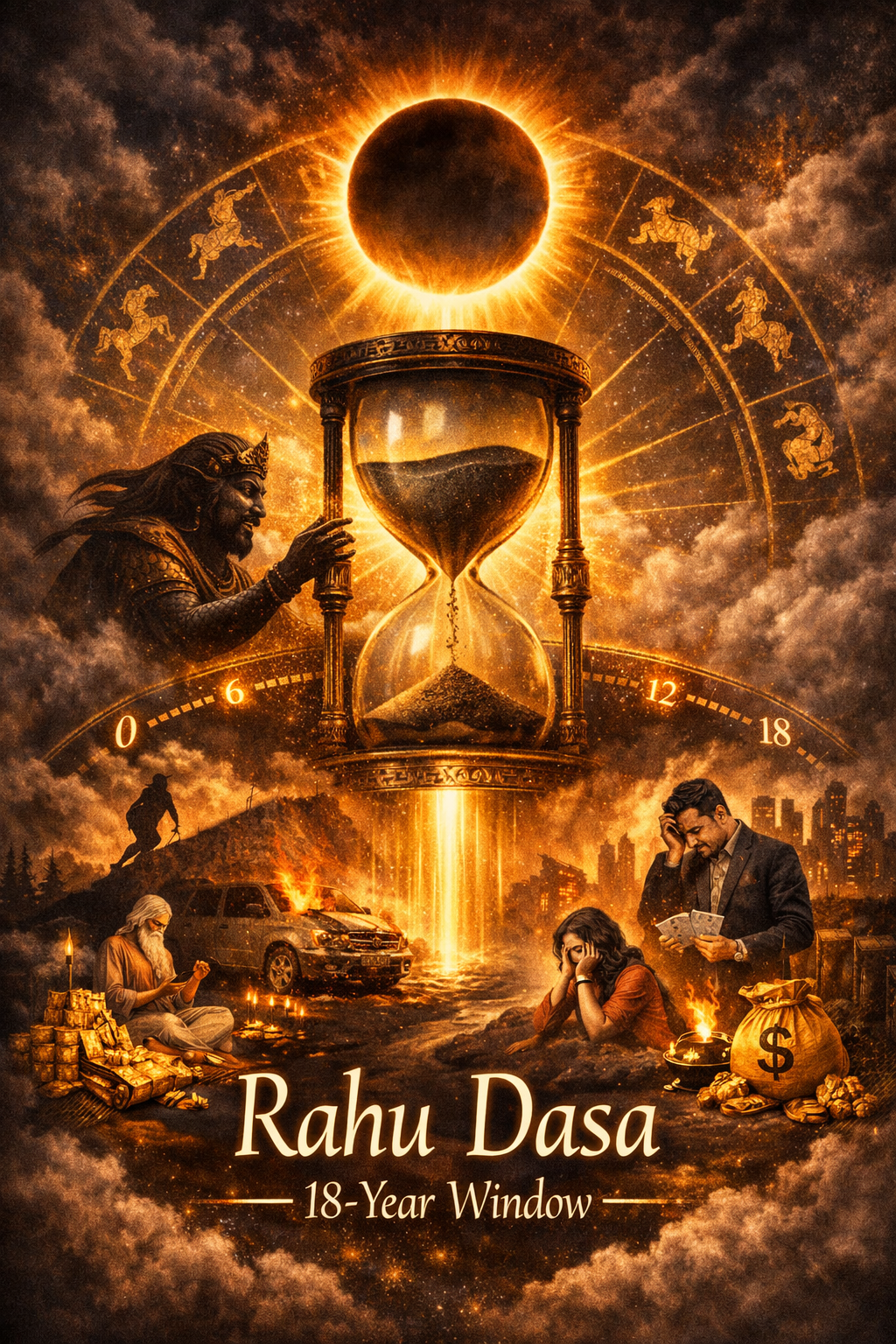
The Vimshottari Dasha system divides life into 120 years across nine planets. Each planet rules a distinct period during which its themes become active in the native's experience. Rahu's period runs for 18 years — the second longest after Venus's 20, and substantially longer than the average planetary period.
Eighteen years is enough time to remake a life. Whatever Rahu has been holding latently in the chart since birth comes into expression during this window. Foreign migration, career restructuring, marriage, childbirth, addiction onset, disease activation, sudden gains, dramatic losses — any major life event whose seed sits in Rahu's interlinks tends to germinate during this period.
This article examines Rahu Dasa in detail: what its 18-year window typically activates, how the experience varies with Rahu's chart placement, what specific Bhukti combinations produce, and how this Dasa fits into the larger Vimshottari sequence.
Position in the Vimshottari Cycle
The full sequence: Ketu → Venus → Sun → Moon → Mars → Rahu → Jupiter → Saturn → Mercury → repeats. Total = 120 years.
Rahu sits between Mars (7 years, action and aggression) and Jupiter (16 years, fortune and dharma). The placement matters.
Mars Dasa typically brings energetic action — career initiative, conflicts, decisive moves. Whatever Mars has been preparing comes to action during its 7 years. Then Rahu takes over, and the Mars-driven actions get amplified to mass scale, often through foreign engagement, technological expansion, or unconventional channels. After 18 years of Rahu, Jupiter arrives — the planet of fortune, consolidation, and dharma. The Rahu expansions, if successful, get blessed and stabilised during Jupiter Dasa. If unsuccessful, Jupiter Dasa often delivers the consequences (liver failure for alcoholics, spiritual reckoning for those who broke too many conventions, family rebuilding for those whose marriages collapsed during Rahu).
Rahu Dasa is therefore both the great expander and the great divider in the cycle. Lives that flourish during Rahu often consolidate beautifully under Jupiter. Lives that struggle during Rahu often face their hardest reckoning under Jupiter.
The Three Nakshatras Rahu Owns
Rahu rules three nakshatras in the zodiac, each spanning 13 degrees 20 minutes:
- Ardra — in Gemini; the storm/transformation nakshatra
- Swati — in Libra; the sword/independence nakshatra
- Shatabhisha — in Aquarius; the hundred healers / mystery nakshatra
A native born when the Moon is in any of these three nakshatras starts life in Rahu Dasa. The remaining years of the 18-year period at birth are calculated based on how far the Moon has progressed through its current nakshatra.
The choice of nakshatras Rahu owns is significant. Ardra is associated with disruption and breakthrough — the storm that clears old patterns. Swati with independence and self-direction — the sword that cuts free. Shatabhisha with hidden healing and mystery — the hundred healers who work in invisible ways. All three carry developmental themes consistent with Rahu's nature: transformation through breaking, expansion through independence, healing through mystery.
What the 18 Years Bring
A Rahu Dasa typically activates whatever themes Rahu carries in the specific chart. The categories of events are predictable; the specific events depend on Rahu's interlinks.
Foreign migration and travel:
- Most common timing for first foreign trip if chart supports
- Permanent migration if the chart's foreign indicators are strong enough
- Foreign job opportunities, international business, foreign clients
- Cross-cultural marriages
- Foreign education
Career restructuring:
- Shifts toward unconventional or international fields
- Industry-level changes affecting the native
- Career growth at scales that earlier Dasas could not produce
- Sometimes career disruption when Rahu is damaged
Sudden expansions:
- Business growth at unexpected scale
- Sudden financial gains, sometimes through unconventional channels
- Networks expanding rapidly
- Reputation extending beyond previous bounds
Marriage and family events:
- First marriage if Rahu favourably engages 7th
- Inter-cultural or unconventional unions
- Childbirth if 5th house engagement is supportive
- Sometimes marital separations or restructurings
Health themes:
- Cancer risk activation (if Rahu connected with 4, 8, 12 plus CSL of organ house)
- Lung and respiratory issues
- Addiction onset or escalation (if Rahu connected with 6, 8, 12)
- Sudden health events
- Allergic and inflammatory conditions
Spiritual or unconventional development:
- Spiritual breakthroughs in unconventional traditions
- Engagement with occult, alternative medicine, foreign spiritual practices
- Mystical experiences or interests
- Departure from family religious tradition
Inheritance and family wealth:
- Paternal-line inheritance arriving (if Rahu connected with 4th)
- Family property transfers
- Wealth from grandfather or paternal ancestors
Mass-scale disruptions:
- Career involvement in events affecting many people
- Living through historical disruptions affecting the native's region
- Mass-event impact on the native's life
These themes do not all manifest in every Rahu Dasa. Which ones manifest depends entirely on what Rahu specifically points to in the natal chart. The themes that can activate are constrained by what Rahu actually engages with.
How Rahu's Placement Shapes the Dasa Experience
The same 18-year period produces dramatically different lives depending on Rahu's chart placement. Several distinct patterns:
Rahu connected with 1, 3, 5, 7, 9, 11 (favourable inner-biased houses): The Dasa supports inner-biased matters. Education, mind development, peaceful expansion, study, communication, family relationships, spiritual development. Even when potential of certain bhavas is weak in the natal chart, this Rahu Dasa can negate the weakness and deliver outcomes that the natal indicators would have blocked.
Rahu connected with 2, 4, 6, 10 (outer-biased material houses): The Dasa supports material gains. Strong wealth accumulation, property acquisition, professional expansion, foreign income, business growth at scale. The native experiences the period as one of significant material progress, often with international or cross-cultural dimensions.
Rahu connected with both groups (favourable inner + favourable outer): The strongest Rahu Dasa configuration. The 18 years bring both material success and personal fulfilment. Career advances, family deepens, fortune flows, and the native often emerges from the Dasa with substantially more than they started with in nearly every dimension.
Rahu connected with 4, 8, 12 (artificial axis damaging): The Dasa brings the negative themes Rahu can produce. Cancer risk activation, addiction onset, refugee-style migration, multiple-loss situations, mass-event involvement on the receiving end. The native experiences the period as one of significant difficulty.
Rahu Karaka Bhava Nashti (Rahu as CSL of 3, 9, or 12 plus 6, 8, 12 connection): The Dasa specifically destroys the related bhava. 9th CSL = Rahu damaged means foreign matters fail; 12th CSL = Rahu damaged means foreign settlement fails; 3rd CSL = Rahu damaged means short-distance matters and communication fail.
Rahu connected with 5 or 9 only without 2, 6, 10: Dharmic-only mode. Spiritual or educational engagement without material gain. The native may have profound experiences during the Dasa but limited financial development.
The lesson: Rahu's Dasa is one of the most variable Dasa experiences across different charts. A friend's good Rahu Dasa and your difficult Rahu Dasa, run during the same calendar years, look like completely different periods of life because the underlying chart configurations differ.
The Bhuktis Within Rahu Dasa
The 18-year Dasa subdivides into Bhuktis ruled by each of the nine planets. The sequence within Rahu Dasa starts with Rahu's own Bhukti (Rahu-Rahu), then proceeds through Jupiter, Saturn, Mercury, Ketu, Venus, Sun, Moon, and Mars. Each Bhukti's duration is proportional to that planet's full Dasa period.
Rahu-Rahu Bhukti (~2 years 8 months): Pure Rahu influence. The strongest activation of Rahu's themes, for better or worse depending on chart placement. Often when major Rahu events happen — first foreign trip, marriage, business launch, addiction onset, disease diagnosis. The combination of Dasa Lord and Bhukti Lord both being Rahu intensifies whatever Rahu engages.
Rahu-Jupiter Bhukti (~2 years 4 months): Rahu's expansion meets Jupiter's fortune. Often a constructive Bhukti for foreign success — Jupiter is the third foreign planet, and the combination supports international gains. Marriage often happens in this Bhukti when chart supports. Spiritual development with unconventional flavour. Educational milestones.
Rahu-Saturn Bhukti (~2 years 10 months): Rahu's expansion meets Saturn's structure. The longest of Rahu's Bhuktis. Often produces durable institutional commitments — long-term career roles, institutional relationships, sustained foreign settlement. Slow but meaningful outcomes. The two malefic-aligned planets together can also produce difficult periods if both are damaged in the natal chart.
Rahu-Mercury Bhukti (~2 years 6 months): Rahu's expansion meets Mercury's analytical sharpness. Excellent for IT, communication, foreign business, writing, analytical work. Tuition centres, consulting practices, communication-heavy careers often launch during this Bhukti.
Rahu-Ketu Bhukti (~1 year): The two shadow planets together. Often produces breakthrough or breakdown — Ketu's contraction balancing Rahu's expansion in dramatic ways. Spiritual experiences common, sometimes accompanied by material setbacks (Ketu's dissolution). Health themes intensify.
Rahu-Venus Bhukti (~3 years): Rahu's longest Bhukti within its Dasa. Marriage often occurs here when chart supports. Pleasure, vehicles, hormonal events. For natives whose Venus is well-placed, often a comfortable and prosperous period. For damaged Venus, possibly relationship difficulties or Venus-disease activation.
Rahu-Sun Bhukti (~10 months): Rahu's expansion meets Sun's authority. Government positions, recognition, leadership opportunities, father-related events. Brief but often significant in career terms.
Rahu-Moon Bhukti (~1 year 6 months): Rahu's expansion meets Moon's sensitivity. Family events, mother-related matters, emotional restructurings. Moon is always in the star of the Dasa Lord and sub of the Bhukti Lord — so during Rahu Dasa, Moon's star lord is Rahu throughout.
Rahu-Mars Bhukti (~1 year): Rahu's expansion meets Mars's action. Often the most action-driven Bhukti within Rahu Dasa. Initiative, conflict, sudden moves. For natives with strong Mars, productive period. For damaged Mars, accident risk or conflict damage.
A native experiencing a particular Bhukti within Rahu Dasa should examine both planets in the chart. If Rahu is well-placed but the Bhukti planet is damaged, the Bhukti may bring trouble within an otherwise favourable Dasa. If Rahu is damaged but the Bhukti planet is well-placed, the Bhukti may bring relief within an otherwise difficult Dasa.
Rahu as a Slow-Moving Planet
Rahu is one of the slow-moving planets, alongside Saturn, Ketu, and Jupiter. This has specific implications for transit analysis during Rahu Dasa.
Rahu in one nakshatra lasts approximately several months. Rahu in one sub-lord lasts approximately several weeks. Compared to fast-moving planets like Sun (one star in 13-14 days, one sub in 1-2 days), Rahu's transit is glacially slow.
This matters because when Rahu is the Cuspal Sub Lord of any house, Rahu's transit becomes a meaningful timing factor. The transit window persists long enough to influence events. A Rahu transit of several months in a particular star is enough time for events to develop fully and complete their arc.
For fast-moving planets, the transit passes too quickly for transit-based timing to register meaningfully. For Rahu and other slow planets, transit timing becomes a useful tool when the planet is the relevant house's CSL.
During Rahu Dasa specifically, paying attention to Rahu's transit position helps fine-tune timing predictions. When Rahu transit aligns with the Bhukti and Antara to favour a particular event, the event tends to land precisely. When Rahu transit conflicts (for example, transiting over the star or sub of CSL of 6, 8, 12 houses), even otherwise favourable Bhuktis may produce delays or unexpected obstacles.
The Permanence of Significators
A planet's significator — the houses it connects with through its star lord and sub lord at birth — is permanently fixed. If Rahu is connected with 3, 9, 12 in a chart, that connection holds for life.
This principle has critical implications for Dasa analysis. Whether Rahu is operating as Dasa Lord, Bhukti Lord, or Antara Lord, its connection remains 3, 9, 12. The themes activated during Rahu's periods will always be 3-9-12 themes, regardless of which level Rahu is operating at.
What changes between levels is the intensity and duration of Rahu's expression:
- As Dasa Lord — long period (18 years), broad activation of Rahu's themes, slow-developing events
- As Bhukti Lord — medium period (typically 2-3 years within someone else's Dasa), specific events can be brought to completion
- As Antara Lord — short period (weeks to a few months), fine-tuning of timing within the Bhukti
For specific events to manifest, the Bhukti Lord typically does the heavy lifting — it has enough duration to take over one event and complete it. The Dasa Lord covers the general theme; the Antara Lord fine-tunes the precise timing.
This is why the Cuspal Sub Lord (corresponding to Bhukti level) carries 60% weight in chart analysis. The Sub-Sub Lord (Antara level) carries 25%. The Star Lord (Dasa level) carries only 15%. The Bhukti has the most decisive influence on whether events actually manifest.
Rahu Dasa as a Restoration Window
One of the most valuable applications of Rahu Dasa appears in charts with weak natal potential for specific bhavas. As covered in the Saturn Parallel article, Rahu Dasa with favourable interlinks can restore outcomes that the natal CSL alone would have blocked.
Practical example from the source material: a native with weak 4th Cuspal Sub Lord (basic education indicator), normally suggesting incomplete schooling. But Rahu Dasa runs from age 3 to 21 with Rahu connected to 1, 3, 5, 7, 9, 11. The Dasa engages education-favourable houses. Even though the natal 4th SL is damaged, the favourable Rahu Dasa during education years delivers full education successfully.
This pattern repeats across many life areas:
- Weak 7th SL (marriage indicator) but Rahu Dasa during marriage age with favourable connections → marriage happens successfully
- Weak 5th SL (childbirth indicator) but Rahu Dasa during fertility age with favourable connections → children come
- Weak 10th SL (career indicator) but Rahu Dasa during career-formation years with favourable connections → career establishes well
The 18-year duration of Rahu Dasa makes it particularly powerful as a restoration mechanism. An entire phase of life can be lifted by Rahu's favourable engagement during that window.
Rahu Dasa When It Disappoints
Not every Rahu Dasa fulfils its potential. When Rahu is connected with 8 or 12, or when Karaka Bhava Nashti is present, the Dasa may bring difficulty rather than expansion.
Specific patterns to watch for:
- Foreign attempted but not arriving — Rahu damaged, foreign dimension blocked even when other indicators look reasonable
- Foreign migration as refugee pattern — going abroad but losing rather than gaining
- Cancer or chronic disease activation — when Rahu is connected with 4, 8, 12 plus CSL of organ house
- Addiction development — when Rahu is connected with 6, 8, 12 plus 6th SL = Rahu
- Mass-scale loss involvement — career or financial setbacks tied to industry-level or political-level events
- Marriage damage — when Rahu = 7th SL plus 4-8-12 connection
When Rahu Dasa produces these difficulties, the diagnosis is usually that Rahu's chart placement was already damaged, and the Dasa simply activated what the chart had been holding latently.
The remedy in such cases focuses on:
- Avoiding the substances and behaviours that the chart's negative Rahu signature would compound
- Maintaining medical screening for organs the chart identifies as at risk
- Building support systems that can absorb the difficulties when they arrive
- Aligning lifestyle with the natural rather than the artificial axis
These are not magical fixes. They are practical responses that reduce exposure to factors that compound Rahu's negative expressions.
The Position of Rahu Dasa in a Life
Where Rahu Dasa falls in the life arc matters significantly. An 18-year window beginning at age 5 produces childhood and adolescence under Rahu's themes. Beginning at age 25 produces young adulthood. Beginning at age 45 produces middle age. Beginning at age 60 produces later life.
In each case, Rahu's themes interpret through the life stage they encounter:
- Foreign migration in early Rahu Dasa = childhood relocation (parents emigrating, native growing up in foreign country)
- Foreign migration in middle Rahu Dasa = career-driven relocation as adult
- Foreign migration in late Rahu Dasa = retirement migration, often to be near children who emigrated earlier
- Career restructuring in early Rahu Dasa = career formation in unconventional fields
- Career restructuring in middle Rahu Dasa = mid-career reinvention or expansion
- Career restructuring in late Rahu Dasa = late-career consulting, advisory, or teaching roles
The chart's specific Dasa balance at birth determines where Rahu Dasa falls. Some lives experience Rahu early, set the foundation through expansion and breach of convention, and then move through other Dasas. Others experience Rahu late, after many other planetary themes have shaped the life, and Rahu's expansions arrive on top of an already-formed life structure.
Why Rahu Dasa Matters
Of the 120 years of the Vimshottari cycle, the 18 years of Rahu Dasa carry a particular significance. They are the years most directly tied to expansion, foreign engagement, and the breaking of inherited patterns. They are the years when the artificial planet operates as the lead planet.
For natives whose Rahu is well-placed and connected to favourable houses, this Dasa is often remembered as a period of substantive transformation — a phase when life took new shape, when previously impossible expansions became possible, when the conventional path was either left behind constructively or transcended through scaling. Many of life's most significant geographic, professional, and relational changes happen in this window.
For natives whose Rahu is damaged, this same Dasa may be remembered as a period when expectations went unmet, when difficult transitions happened, when health or addiction or migration took painful forms. The 18 years feel long when they are difficult.
Either way, Rahu Dasa is one of the periods most worth understanding in advance. Knowing when it begins, what it can activate, what its specific configuration in the chart will produce — this knowledge allows the native to make use of the period rather than be surprised by it.
For natives in their Rahu Dasa, the practical question is: What is Rahu actually pointing to in my chart, and how do I work with that rather than against it? The answer to that question, taken seriously, often determines whether the 18 years deliver expansion or difficulty, and whether the Jupiter Dasa that follows arrives to bless completed work or to deliver consequences for unaddressed damage.
The next article in this series turns to the comparison that completes Rahu's picture — Rahu vs Ketu, the diametric pair, and how their combined operation shows up in mundane astrology and mass-event analysis.


Comments ()