Ketu's Spiritual Role — Enlightenment, Moksha, and the Contemplative Path
Article 9 of the Ketu Series in Astrology
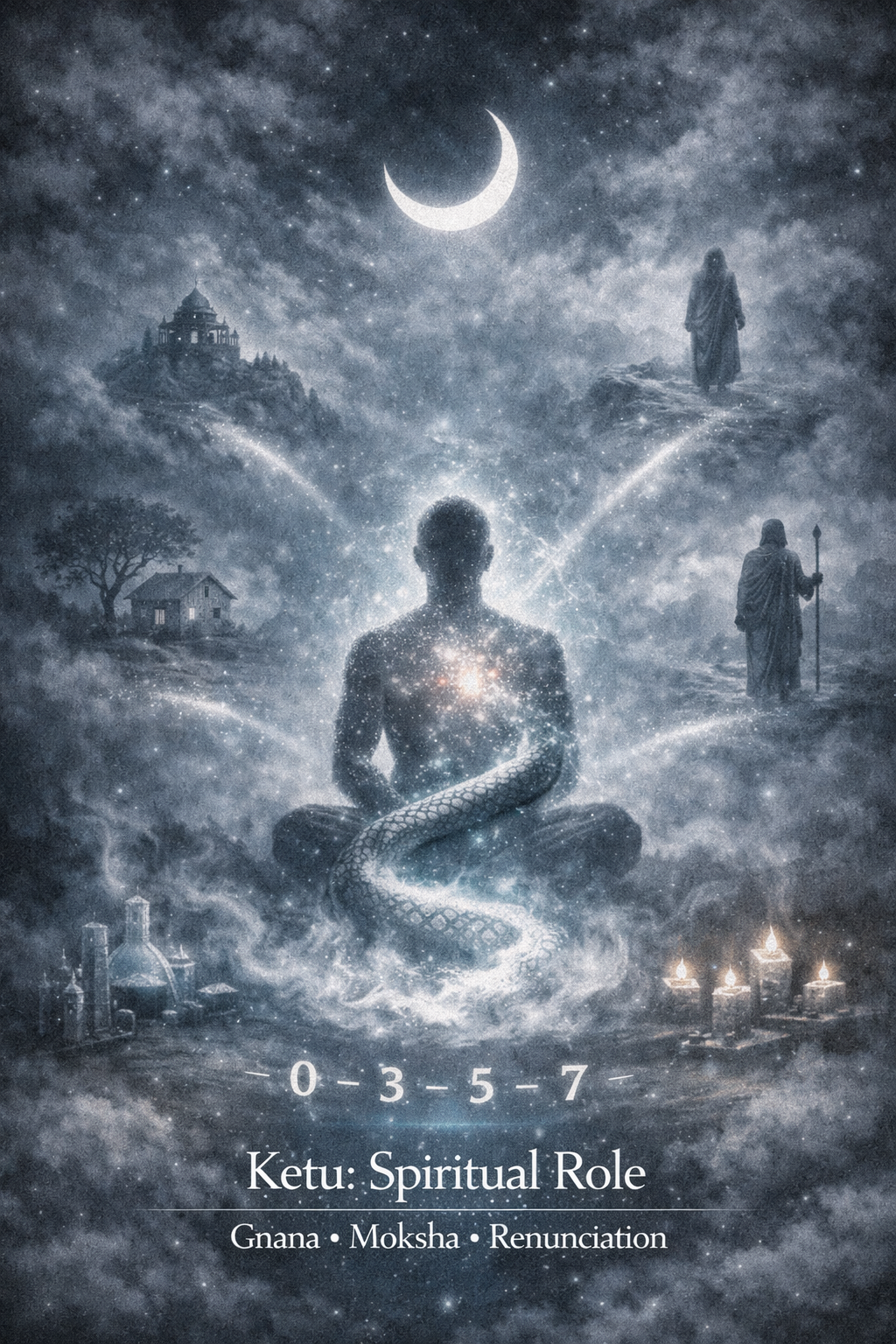
Of all the planets in astrology, Ketu carries one of the most distinctive contributions: it is the karaka of enlightenment. While Jupiter governs wisdom and dharma broadly, while the 12th house represents loss of ego-attachment generally, Ketu specifically signifies the realisation that ends seeking — the gnana that completes the spiritual path.
This role has no equivalent among the natural planets. Saturn brings discipline, restriction, and the structure that supports practice. Jupiter brings the wisdom of teachers, the protection of dharma, the blessing of the path. The 9th house represents the dharmic life. The 12th house represents the dissolution of attachment. But the realisation itself — the gnana, the recognition that "all things are with God," the contraction of personal will into surrender — this is Ketu's specific territory.
This article examines Ketu's spiritual role in detail: why this particular planet carries the enlightenment karaka, the framework of contemplative practice in chart analysis, the 12th house connection for moksha and sannyasa, the specific combinations supporting genuine spiritual development, and how Ketu's spiritual signature interacts with the other planetary indicators of inner life.
Why Ketu Is the Enlightenment Karaka
The reasoning runs through the contraction principle. Ketu's signature operation is contraction — making things smaller, drawing inward, reducing to essence. Worldly ego is large, expansive, claiming. It says "I am, I want, I deserve." Spiritual realisation requires the opposite movement — making the ego small, surrendering personal claims, recognising that "all things are with God" rather than with personal will.
This is precisely Ketu's contraction principle applied to the spiritual dimension. The same operation that produces physical organ shrinkage in the body produces ego shrinkage in spiritual practice. The same principle that demolishes worldly structures dissolves the ego's grip on personal identity.
Where Rahu (the snake's head) represents arrogance and outward grandeur, Ketu (the snake's tail) represents humility and inward refinement. The tail of the snake, almost invisible but providing balance, becomes the symbol for the enlightened mind — having made itself small in the worldly sense to become large in the spiritual sense.
The snake symbolism captures the entire spiritual paradox. The aspect of self that grasps for prominence (Rahu) must be released so that the aspect of self that knows its true smallness in the cosmic scheme (Ketu) can come forward. Spiritual practice is the gradual transfer of attention from the head to the tail — from outward grasping to inward recognition.
The Specific Spiritual Karakas
Ketu's spiritual karakas span the full territory of contemplative life:
Enlightenment (Gnana) — the realisation that ends seeking. Ketu as the karaka points to the chart's potential for genuine spiritual realisation in this life.
Sages who live in self-control — those who have mastered the ego's expansive demands, who live with restraint and discipline. The sage tradition across cultures shares Ketu's signature.
Sages relieved from worldly pleasures — those who have moved past attachment to material satisfaction. The capacity to find sufficiency in less, even in nothing, is Ketu's territory.
Sannyasa (renunciation) — the formal path of leaving worldly life for spiritual practice. When chosen as a life direction, sannyasa carries Ketu's signature directly.
Moksha (liberation) — the ultimate spiritual goal of release from the cycle of birth and death. Ketu shares this karaka with Saturn for the 12th house, but with different emphasis (Saturn = the structure of confinement that enables moksha; Ketu = the realisation that completes it).
Heaven (in the spiritual sense) — Ketu connects with the destinations of advanced spiritual practice. The traditional understanding of heaven as the abode of liberated souls fits Ketu's territory.
Meditation and contemplative practice — the inward-turning practices that align with Ketu's contraction principle.
Past-life karmic clearing — Ketu carries the karaka for working through accumulated karma, particularly the karma that requires inner rather than outer resolution.
Mystical and psychic experience — Ketu's "subtle" signature extends to the experiences that arise in deep contemplative practice.
Recognition of impermanence — the realisation that all worldly forms are subject to change and dissolution. Ketu's contraction principle applied to understanding produces this recognition naturally.
The 12th House Connection
The 12th house represents the final house of the chart — the dissolution of attachment, the loss of worldly identity, the threshold of liberation. Ketu is one of the primary 12th-house karakas alongside Saturn.
The two planets contribute different aspects:
- Saturn for the 12th — the structural confinement that enables practice; the discipline of monastery life, cave practice, monastic enclosure; the patience required for sustained inner work; the slow dissolution of identity over time
- Ketu for the 12th — the realisation that completes practice; the dissolution of ego itself; the sudden recognition that breaks through after long preparation; the gnana that ends seeking
When both planets favourably engage the 12th house, the chart supports the complete spiritual path — the structural foundation through Saturn, the realisation through Ketu. When only one engages, the path may proceed through that planet's contribution while lacking the other's support.
The 12th house's specific spiritual meanings:
- Monastic life — formal monastery membership
- Ashram living — Indian-tradition spiritual community
- Sannyasa — formal renunciation status
- Meditation retreats — temporary intensive practice periods
- Spiritual confinement — cave practice, monastery enclosure, hermit life
- Loss of ego-attachment — the gradual or sudden release of personal identification
- Final liberation — moksha as life completion
When Ketu is favourably connected with the 12th house, the chart indicates spiritual capacity that may manifest as serious contemplative practice, monastic engagement, or genuine inner development. When connected with 5 and 9 (the inner-biased dharmic houses) without 4, 8, 12 damage, the spiritual development tends toward constructive integration with worldly life rather than full renunciation.
The Chart Pattern for Genuine Spiritual Development
Several converging factors produce charts that support genuine spiritual development:
Ketu favourably placed — particularly connected with 5, 9, 12 in supportive ways. This is the central indicator.
Jupiter supporting — wisdom, dharma, guru blessing. Jupiter connected with 5, 9 brings the dharmic dimension that supports spiritual practice.
5th house engaged — past-life merit (purva punya), capacity for spiritual practice. Without 5th house support, the chart may show interest in spirituality without the underlying capacity for sustained development.
9th house engaged — dharma, divine grace, pilgrimage. The 9th house represents the higher mind oriented toward spiritual matters.
12th house engaged — moksha indicators, monastic capacity. The final house specifically supporting the dissolution of worldly attachment.
Lagna with spiritual orientation — when the Lagna's CSL connects with 5, 9, 12, the personality itself is spiritually oriented from foundation level.
When these align, the chart supports spiritual development that may be one of the native's most significant life arcs. When they fail to align, spiritual interest may exist but lack the structural foundation for sustained practice.
The Different Spiritual Modes
Charts with Ketu spiritual involvement may produce different modes of spiritual life:
Householder spirituality — when Ketu connects with 5, 9 but not strongly with 12, the native develops spiritually within ordinary worldly life. Marriage, family, profession continue alongside contemplative practice. The native may meditate daily, attend spiritual gatherings, study spiritual texts, develop genuine inner depth — all without leaving worldly life.
Periodic intensive practice — when Ketu engages 12th but not in renunciation-supporting ways, the native may take periodic retreats, spend time in monasteries or ashrams, engage in intensive practice while maintaining worldly life otherwise. The spiritual life is significant but not exclusive.
Renunciation as life path — when Ketu, Saturn, and 12th house combine in specific ways, the native may take formal sannyasa. Worldly life ends; spiritual life becomes complete focus. Marriage, family, profession all release. This is the most dramatic mode and the rarest in actual occurrence.
Spiritual teaching career — when Ketu connects with 10th plus 5, 9 supporting, the native may develop spiritual teaching as profession. This can range from informal mentoring to full-time spiritual direction work.
Occult/mystical specialisation — when Ketu connects with 8th house plus spiritual support, the native may develop genuine occult or mystical capacities. Distinct from black magic (which requires damaging interlinks), this is constructive engagement with subtle forces.
Intellectual spiritual orientation — when Ketu combines with Mercury and Jupiter, the native may engage spirituality primarily through study, scholarship, philosophical inquiry rather than direct contemplative practice.
The chart shows which mode is most natural for the native. Forcing a different mode against the chart's indication often produces frustration; aligning practice with the chart's natural pattern often produces deeper engagement.
Ketu Dasa as the Primary Spiritual Window
Ketu Dasa is often the most spiritually productive period in life for natives whose chart supports it. The 7-year window may bring:
- First serious spiritual practice — meditation, contemplative discipline, study of spiritual texts
- Initiation into traditions — receiving teachings from gurus, joining specific lineages
- Pilgrimage — visits to spiritual sites become meaningful
- Retreat experiences — time away from worldly activity for inner work
- Spiritual breakthroughs — recognition events, deepenings of understanding
- Renunciation considerations — for natives whose chart supports it
- Teaching capacity emerging — beginning of spiritual teaching work
The contraction-toward-essence principle aligns with serious contemplative practice. Whatever the native has been holding spiritually in latent form often comes to expression during this window.
For natives encountering Ketu Dasa during youth or middle age with chart support, the spiritual development that begins during this Dasa often becomes the foundation for the rest of life. For natives encountering Ketu Dasa later, the spiritual depth that develops may shape the closing arc of life meaningfully.
The Role of Saturn Alongside Ketu
Saturn and Ketu together support different aspects of spiritual life:
Saturn provides:
- The discipline to sustain practice over years
- The patience for slow development
- The structure of regular practice times
- The capacity to live with reduced material circumstances
- The willingness to accept the inevitable difficulties of spiritual path
- The longevity to develop depth over decades
Ketu provides:
- The orientation toward inner rather than outer
- The capacity for non-attachment
- The recognition of essence vs. form
- The contraction of ego that enables surrender
- The realisation that completes the path
- The connection with ancestral spiritual lineage
Charts with both planets favourable in spiritual indicators show the most complete spiritual capacity. The native has both the structural support (Saturn) and the realisation potential (Ketu) for genuine development.
Charts with Ketu strong but Saturn weak may show natives with deep spiritual orientation but difficulty sustaining practice through the long periods of unrewarded effort. Charts with Saturn strong but Ketu weak may show natives capable of disciplined practice without the underlying realisation potential.
The Black Magic and Tantra Dimension
A specific and somewhat sensitive Ketu domain involves the occult arts. The traditional source material identifies Ketu as the karaka for:
Black magic (Manthirigam) — magical practices intended to influence others, often for harmful purposes. The hidden-action karaka of Ketu fits the structural definition of magic that operates without the target's awareness.
Tantric practice — both the constructive and destructive forms. Tantric chemistry, tantric ritual, tantric meditation all involve Ketu's chemical-and-secret signature.
Mantirigam practices — the application of secret formulas, mantras for specific purposes, ritual prescriptions for affecting outcomes.
Occult investigation — the scholarly or practical study of hidden traditions.
Working with subtle forces — the practitioner's engagement with what cannot be directly observed.
The practical reading distinction:
- Strong Ketu connected with 8th house plus favourable interlinks (1, 3, 5, 7, 9, 11) — natural fit for genuine occult work; constructive engagement; contributes to the native's spiritual development
- Strong Ketu connected with 8th house plus damaging interlinks (4, 8, 12) — drawn to occult practice but the practice damages rather than develops the native; this is the signature of natives who experiment with occult practices and develop psychological or health problems
The chart distinguishes between natives whose constitution supports occult work and those whose constitution does not. For the latter group, occult experimentation is structurally risky regardless of the specific practice attempted.
Past-Life and Karmic Themes
Ketu carries karmic-clearing significance in the chart. The planet's contraction principle applies to accumulated karma — reducing, releasing, completing rather than acquiring new commitments.
When Ketu engages favourably with the 5th house (past-life merit) and the 12th house (release/dissolution), the chart suggests:
- Significant past-life spiritual development carrying forward
- Capacity to recognise spiritual teachings as familiar rather than entirely new
- Natural orientation toward practices that serve karmic completion
- Quick spiritual development relative to investment of effort
- Possible recognition of past-life teachers, places, practices
These themes are interpretive rather than provable. They appear in many spiritual traditions as part of how chart analysis discusses spiritual capacity. Natives who resonate with these frameworks often find them meaningful; natives who do not may set these dimensions aside while still finding the chart's spiritual indications useful in other forms.
When Ketu Spiritual Indicators Do Not Manifest
Not every chart with Ketu spiritual signature actually develops the spiritual life. Several factors prevent manifestation:
Material/family pressures dominating — when the surrounding context strongly demands worldly engagement, the spiritual capacity may remain latent through life
Ketu's own placement weak — when Ketu only sits in a house without CSL/SSL/Star Lord roles, the spiritual capacity may exist at low intensity throughout life rather than activating dramatically
Counter-indications from other planets — when Mars, Venus, or Sun strongly demand outer-world engagement, the spiritual orientation may be subordinated
Cultural environment without supportive structures — natives in environments lacking spiritual teachers, practices, or community may lack the external support needed to develop the inner capacity
Personal choice toward worldly life — the chart shows capacity; the native's choices determine whether the capacity is exercised
The chart shows the potential. The potential does not have to become the outcome. This is especially true for spiritual capacity, which (unlike many other chart indicators) requires specific intentional engagement to activate.
Reading the Chart for Ketu's Spiritual Capacity
The practical sequence:
- Check Ketu's CSL positions — does Ketu engage 5, 9, or 12 as Cuspal Sub Lord?
- Check Ketu's interlinks — favourable connections (1, 3, 5, 7, 9, 11) or damaging?
- Check Saturn's position relative to spiritual houses — does Saturn provide the structural support?
- Check Jupiter — does Jupiter support the dharmic dimension?
- Check 12th house specifically — what is the 12th CSL, what does it connect with?
- Check 5th and 9th houses — past-life merit and dharma indicators
- Check Lagna's spiritual orientation — does the Lagna CSL connect with 5, 9, 12?
- Check Ketu Dasa timing — when does the 7-year window run? At what life stage?
The reading produces a complete spiritual capacity profile: which mode is natural (householder vs intensive vs renunciation), what age windows are most supportive, what supporting practices align with the chart's pattern, what challenges the spiritual path will face.
The Practical Implications for Spiritual Life
For natives whose charts show Ketu spiritual capacity, the practical implications include:
- Take the spiritual orientation seriously — the capacity exists structurally; ignoring it may produce ongoing dissatisfaction with purely worldly engagement
- Identify the natural mode — householder, intensive, or renunciation; align practice with the chart's indication rather than forcing a different mode
- Find appropriate teachers and traditions — Ketu's connection with specific traditions often appears in chart; some natives align naturally with specific lineages
- Allow time for development — Saturn's structural support (or its absence) shapes the pace; trying to rush past Saturn's pace often produces premature plateaus
- Watch for the activation windows — Ketu Dasa specifically; also Bhuktis of Ketu within Jupiter or 12th-related Dasas
- Integrate rather than compartmentalise — for householder mode, weave practice into daily life rather than separating "spiritual time" from "worldly time"
- Honour the contraction principle — the spiritual life involves giving up rather than acquiring; resistance to this principle often blocks development
For natives whose charts do not show strong Ketu spiritual capacity, the practical implications are different — meaningful spiritual life is still possible, but may proceed through other planetary supports (Jupiter for wisdom, Saturn for discipline, 9th house for dharma) rather than through Ketu's specific contribution.
The Larger Frame
Ketu's spiritual role represents one of astrology's most distinctive contributions to understanding the human inner life. The planet specifically governs the realisation that ends seeking, the recognition that "all things are with God," the contraction of ego that enables liberation. No other planet covers this territory in the same way.
For natives whose charts engage Ketu's spiritual capacity, this dimension may be among the most significant in their lives. The contemplative depth that develops may shape their identity, their relationships, their professional choices, their entire orientation toward existence. The chart's spiritual indicators identify this capacity in advance and help the native recognise what they are working with structurally.
For natives whose charts do not engage Ketu's spiritual capacity strongly, this dimension may remain a smaller part of life — perhaps appearing as occasional interest in spiritual matters without becoming a defining commitment. This too is the chart speaking truthfully; not every life is structured around spiritual development as central focus.
Either way, recognising Ketu's spiritual signature in the chart helps the native understand one of the most important dimensions of their own potential. The shadow planet, properly understood, illuminates the inward path that other planets only touch tangentially.
The next and final article in this series turns to the most concrete level of chart reading — Ketu as Cuspal Sub Lord of each of the twelve houses, with the smaller-organ rule applied across each, the specific implications for body, life themes, and risk patterns at every position.


Comments ()