Ketu and the Body — Acids, Intestines, and the Smaller-Organ Rule
Article 5 of the Ketu Series in Astrology
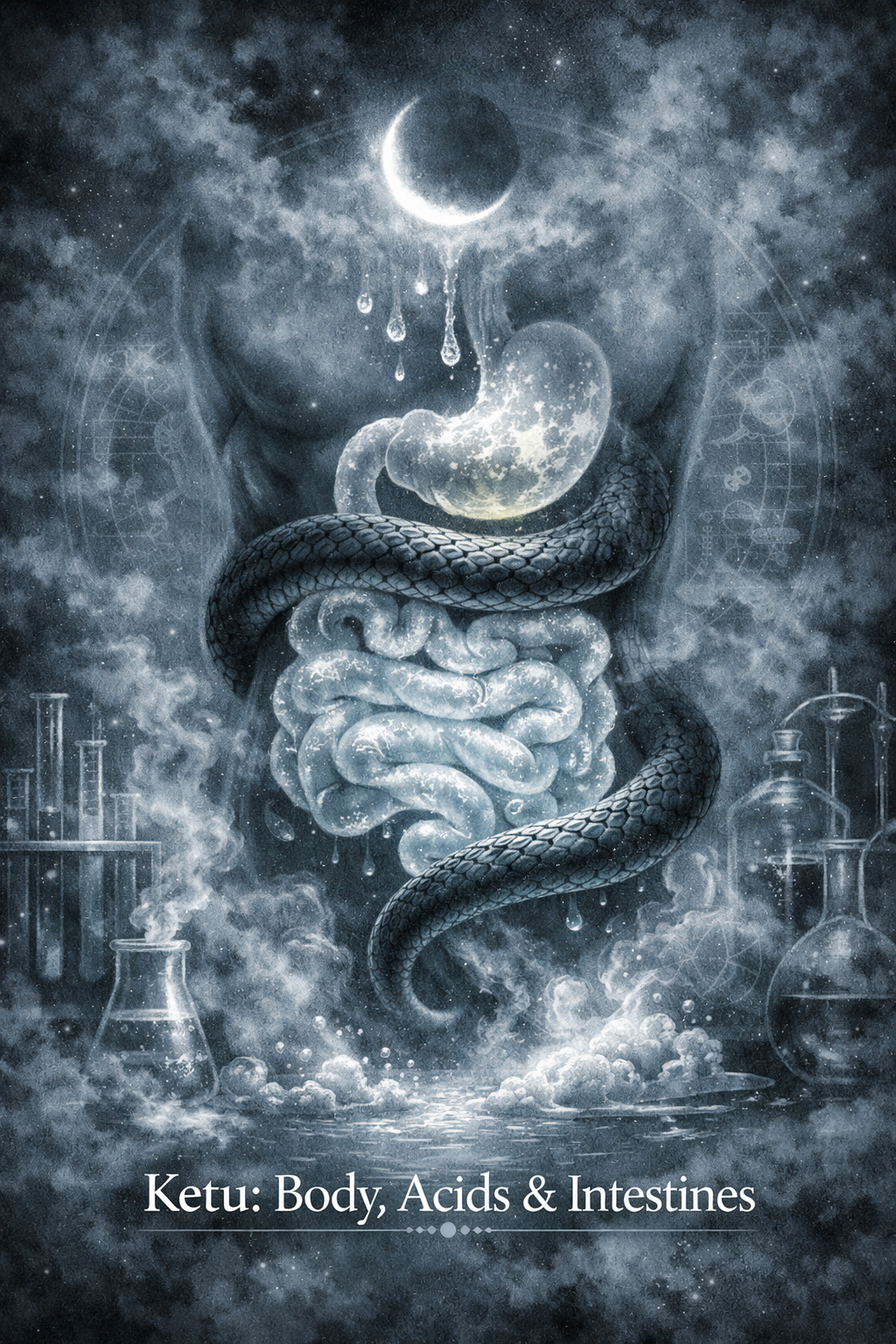
If Ketu's medical karaka covers medicine itself and the chemical processing of substances, Ketu's body karaka covers the specific organs and biological systems where this chemical work happens. The acids of the body, the intestines as long narrow processing tubes, the enzymatic reactions throughout, the smaller-than-normal organ rule when Ketu serves as Cuspal Sub Lord — all together describe the planet's territory in the physical body itself.
This article examines Ketu's body domain in detail: the specific organs governed by the planet, why these particular body parts fall under Ketu rather than other planets, the smaller-organ rule and its consequences, organ deformation and amputation patterns, and the late-detection disease signature that requires natives to compensate through proactive monitoring.
The Acids — Ketu's Primary Inner Karaka
The single most important body karaka of Ketu: all acids secreted by the body, with hydrochloric acid (HCl) in the stomach being the central example.
The reasoning is structural. Acids are chemical substances that initiate or sustain chemical reactions. They break down other compounds into their components. They corrode, dissolve, transform. This is precisely Ketu's signature operation — chemical breaking and processing — applied within the body itself.
Specific body acids under Ketu:
- Hydrochloric acid (HCl) in the stomach — initiates protein digestion, activates pepsin, sterilises ingested food
- Bile acids in the gallbladder and small intestine — emulsify fats for digestion
- Pancreatic digestive acids and enzymes that break down starches, proteins, and fats
- Lactic acid produced by muscle metabolism
- Uric acid from purine metabolism
- Other digestive secretions that maintain the chemical environment for digestion
When Ketu is favourably placed, acid secretion is balanced — adequate amounts at the right times, properly buffered, supporting digestion without causing damage. When Ketu is damaged (connected with 6, 8, 12), acid balance fails:
- Hyperacidity — excessive acid production damaging stomach lining
- Hypochlorhydria — insufficient acid impairing digestion
- Acid reflux (GERD) — acid escaping its proper location
- Peptic ulcers — acid damage to digestive tract
- Gallstones — acid composition imbalance in bile
- Gout — uric acid accumulation
- General digestive acid disorders
These conditions represent failures of Ketu's primary body karaka. Treatment that addresses surface symptoms without addressing Ketu's underlying signature often produces only temporary relief because the structural pattern continues operating.
The Small Intestine — The Long Narrow Processor
Ketu's primary digestive organ is the small intestine — the long, narrow tube where most nutrient absorption happens. The structural fit between organ and karaka is direct:
- Approximately 20-25 feet long but narrow in diameter
- Contrast directly with Rahu's broad expanding lungs
- The narrowness exemplifies Ketu's contraction principle
- The length provides extensive surface area for chemical absorption
- All the chemical breakdown of food into absorbable nutrients happens here
When Ketu is favourably placed, small intestine function operates efficiently — food breaks down completely, nutrients absorb cleanly, the chemical processing proceeds at optimal pace. When Ketu is damaged, small intestine function fails in various patterns:
- Malabsorption syndromes — nutrients not absorbed despite adequate food intake
- Intestinal inflammation (Crohn's disease, ulcerative colitis affecting small intestine)
- Bacterial overgrowth (SIBO) — wrong microbes colonising the wrong locations
- Leaky gut syndrome — barrier function failing
- Intestinal cancer of the spread variety (when 4-8-12 axis fully engaged)
- Adhesions and obstructions — physical blockages requiring intervention
The small intestine being Ketu's primary organ means digestive symptoms often point to Ketu damage rather than to other planetary issues. Charts with persistent small-intestine problems should be examined first for Ketu's interlinks.
The Large Intestine — Elimination
Ketu also rules the large intestine (big intestine) — the elimination passage where waste material is processed for removal.
The large intestine handles:
- Water absorption from waste material
- Bacterial fermentation of unabsorbed nutrients
- Formation and storage of solid waste
- Final elimination through the rectum
Ketu damage at this level produces:
- Constipation patterns — slow elimination, hardening of waste material
- Diarrhoea patterns — incomplete absorption, watery elimination
- Irritable bowel syndrome (IBS) — alternating patterns
- Diverticular disease — outpouchings and inflammation
- Colorectal cancer of the spread variety
- Chronic colon inflammation
The two intestines together represent Ketu's primary territory in the digestive system. Conditions affecting either or both fall directly under Ketu's signature.
Chemical Reactions Throughout the Body
Beyond the digestive system specifically, Ketu rules all chemical reactions throughout the body. Every enzymatic reaction, every hormone synthesis, every neurotransmitter production, every conversion of one substance into another — all fall under Ketu's chemical processing karaka.
This is an enormous territory. Some examples:
- Liver detoxification reactions — chemical breakdown of toxins for elimination
- Hormone synthesis — chemical creation of insulin, thyroid hormones, sex hormones, stress hormones
- Neurotransmitter production — chemical synthesis of dopamine, serotonin, acetylcholine, GABA
- Energy metabolism — chemical conversion of glucose to ATP
- DNA replication and repair — chemical accuracy of genetic processes
- Immune system chemistry — chemical signalling between immune cells
- Drug metabolism — chemical processing of pharmaceuticals
- Alcohol metabolism — chemical breakdown of consumed alcohol
- Cell membrane chemistry — chemical maintenance of cellular integrity
When Ketu is favourably placed, these chemical processes run cleanly. When damaged, multiple chemical systems may fail simultaneously, producing what looks like a constellation of unrelated symptoms but reflects a single underlying pattern of compromised chemical processing.
This explains why some natives experience clusters of seemingly unrelated chemical-related conditions — hormone imbalances plus digestive issues plus medication sensitivities plus energy metabolism problems. The chart often shows a single Ketu damage pattern producing multiple chemical-system manifestations.
Digestive Efficiency — The Practical Karaka
The most actionable Ketu body karaka in everyday life is digestive efficiency — the quality with which the body extracts energy and nutrients from food.
The mechanism layers all of Ketu's body karakas together:
- Acid secretion initiates digestion
- Enzyme activity continues breakdown
- Small intestine absorbs nutrients
- Chemical conversion processes prepare nutrients for cellular use
When all four operate well, digestive efficiency is high. The body extracts maximum energy and nutrients from food. The native may eat moderately and remain well-nourished. Energy levels stay stable. Recovery from physical activity proceeds quickly.
When any of the four operates poorly, digestive efficiency drops. The body extracts less from the same food. The native may eat well but feel undernourished. Energy levels may fluctuate. Weight maintenance may require more food than peers consume.
The illustrative example: two natives eat identical meals of 4 idlis. Native A's body processes the meal to 250 calories of usable energy. Native B's body processes the same meal to 350 calories. The 100-calorie difference reflects digestive efficiency — Ketu's signature in operation.
For chart reading, digestive efficiency emerges from examining Ketu's overall placement and interlinks. Strong Ketu produces efficient processing. Damaged Ketu produces inefficient processing regardless of food quality.
The Smaller-Organ Rule
When Ketu is the Cuspal Sub Lord of any house, the body organ corresponding to that house becomes smaller than normal size. This is true regardless of disease. The organ simply has smaller physical dimensions than typical for the native's frame.
Examples:
- Ketu as 2nd CSL — smaller nose, smaller eyes, smaller teeth (the 2nd house governs face and oral region)
- Ketu as 3rd CSL — smaller arms and shoulders
- Ketu as 4th CSL — smaller chest cavity
- Ketu as 5th CSL — smaller stomach and abdominal area
- Ketu as 6th CSL — smaller lower abdomen
- Ketu as 7th CSL — smaller hip and lower back region
- Ketu as 8th CSL — smaller reproductive organs
- Ketu as 9th CSL — smaller thigh region
- Ketu as 10th CSL — smaller knee structure
- Ketu as 11th CSL — smaller lower leg
- Ketu as 12th CSL — smaller feet
This is purely physical. The organ is smaller. There is no disease implication unless additional conditions are met.
The smaller-than-normal feature can be observed in many natives. A noticeably small nose, dainty hands, narrow shoulders, slim build through the chest, small feet — physical features at the smaller end of the normal range often correspond to Ketu CSL placements at the relevant houses.
When Smaller Becomes Diseased
The smaller-organ rule transforms into disease combinations when the additional condition appears: Ketu is the CSL of a house AND is connected with 6, 8, or 12.
When both conditions hold, the smaller organ may not cooperate properly. Several patterns emerge:
- Deformation — the organ takes on irregular shape over time
- Amputation possibility — physical removal becomes necessary in extreme cases
- Organ failure — function compromised even when structure remains
- Cancer of the spread variety — when the cancer combination activates fully
- Chronic dysfunction — persistent problems with the organ's normal operation
The key sequence for Ketu damage parallels Rahu's: smaller organ → vulnerability to disease → disease development if 4-8-12 axis fully engaged.
This is why the same physical feature — a notably small nose, narrow chest, small hands — can be either harmless or worrying, depending on other interlinks. The physical sign is the same; the underlying combination is different.
Amputation and Organ Removal
A specific Ketu signature: amputation, the surgical removal of body parts.
The combination involves:
- Ketu providing the removal/contraction principle
- Mars providing the surgical action karaka
- The relevant body part's house — where the amputation will occur
- 6, 8, or 12 connection — the disease/sudden event/loss damage
When these factors converge, surgical removal of body parts becomes structurally indicated:
- Limbs amputated due to severe injury, infection, or vascular compromise
- Reproductive organs removed surgically (hysterectomy, oophorectomy)
- Sections of intestine removed due to disease
- Breast removal due to cancer
- Other organ removal procedures
The Ketu Dasa or Ketu Bhukti is often when the amputation event lands when the chart supports it. The 7-year window provides timing for the medical situation requiring removal to develop and reach the surgical decision point.
Late Detection — The Critical Diagnostic Pattern
Perhaps the most important Ketu body signature: diseases under Ketu's influence tend to be undiagnosed early.
The mechanism aligns with Ketu's "secret" karaka. The disease operates below the surface of obvious symptoms:
- The body's signalling is generalised or weak
- Symptoms are non-specific and easily attributed to other causes
- Doctors prescribe based on apparent symptoms without identifying the actual condition
- Multiple medical visits may pass without clear diagnosis
- The disease's true nature becomes apparent only at advanced stage
This pattern affects multiple Ketu-related diseases:
- Cancer of the spread variety (covered in detail in Article 3)
- Chronic chemical sensitivities that develop gradually
- Medication side effects that emerge slowly
- Hormonal imbalances that develop over years
- Digestive disorders that progress before being addressed
- Autoimmune conditions affecting chemical systems
- Neurological conditions with chemical basis (early Parkinson's, early dementia)
For chart analysis, identifying the late-detection signature in advance is one of the most valuable applications. The native learns that their body's signalling will be subtle, that they cannot rely on dramatic symptoms to indicate problems, and that they must compensate through proactive monitoring.
The Body Warranty Period
A general principle that applies across all health analysis: when the primary health factors (Sun, Moon, Ketu, Lagna, 6th, 8th, 12th houses) are all favourable, diseases from other planets typically manifest only after age 60. This is described as the body's natural warranty period.
When two or more of these primary factors are connected with 6, 8, or 12, disease can manifest from age 25, with continuous treatment needed from age 30-40.
For Ketu specifically: a chart with damaged Ketu but strong primary trio may carry the chemical-disease signature without it ever manifesting clinically, because the body's general resistance keeps the disease at bay. A chart with damaged Ketu and damaged primary trio has both the chemical disease combination and no buffer against it — the highest-risk profile.
Reading the Chart for Ketu Body Health
The practical sequence:
- Identify which houses have Ketu as CSL — these are the candidate organs for smaller-than-normal size
- Check the interlinks of Ketu — connected with 4, 8, 12 through star and sub lords?
- Identify the primary disease patterns — chemical, digestive, intestinal, late-detection
- Check Lagna — Lagna damage compounds disease risk
- Check the primary trio (Sun, Moon, Ketu) — overall resistance to chemical disease
- Check Rahu in parallel — both shadow planets together for cancer risk
- Check the running Dasa at relevant age windows
- Identify protective factors
The reading produces not a yes-no prediction but a layered risk profile: which organs are most at risk, what age windows are most concerning, what protective factors are operating, what the running Dasa adds.
Practical Implications for Ketu Body Health
For natives whose charts show damaged Ketu in body-relevant ways, the practical responses align with general medical wisdom but with specific Ketu emphasis:
- Proactive comprehensive screening — given the late-detection signature; annual blood work, periodic comprehensive imaging, immediate investigation of generalised symptoms
- Pay attention to subtle symptoms — unexplained fatigue, generalised pain, gradual weight changes, persistent digestive issues — symptoms that conventional medicine often dismisses deserve investigation
- Support digestive function actively — adequate hydration, fibre, supportive nutrition, attention to gut health, possibly digestive enzyme support
- Cautious medication use — discuss starting doses, side effect monitoring, drug interactions with prescribers; the body's processing may not handle standard doses optimally
- Reduce unnecessary chemical exposure — pesticides, processed food chemicals, environmental toxins compound the body's chemical processing burden
- Build chemical resilience — adequate protein for enzyme synthesis, adequate fat for hormone production, antioxidant nutrition for cellular protection
- Maintain regular elimination — both intestines functioning well prevents accumulation of waste products
- Sleep quality — many chemical reactions in the body run during sleep; chronic sleep disruption compounds Ketu damage
These are not magical remedies. They are interventions that reduce the body's exposure to factors that compound Ketu's negative expression and that catch disease earlier when treatment is more effective.
The Ketu Body Profile
A native with strong well-placed Ketu typically exhibits:
- Efficient digestion, normal weight on moderate food intake
- Clean drug response — standard doses work as expected
- Good acid balance — neither hyper nor hypoacidic
- Healthy intestinal function
- Quick recovery from chemical illness
- Generally healthy chemical processing throughout
A native with damaged Ketu typically exhibits:
- Inefficient digestion despite good food choices
- Unpredictable drug responses, sensitivity to medications
- Acid imbalances of various types
- Persistent digestive issues
- Slow recovery from chemical illness or chronic chemical conditions
- Multiple seemingly unrelated chemical-related symptoms
The chart's Ketu signature explains much of what otherwise looks like a constellation of unrelated health quirks. Identifying the underlying pattern helps the native understand their body's particular tendencies and respond accordingly.
The Larger Frame
Ketu's body karaka represents one of the most precise contributions of chart analysis to health understanding. While Sun governs overall vitality and Moon governs daily wellbeing, Ketu specifically addresses the chemistry of the body — the often-invisible biochemical processes that determine how well everything else functions.
For natives whose Ketu is favourably placed, this dimension may operate so cleanly that they barely notice it. Digestion just works. Medications just respond. Chemical illnesses just resolve. The native takes their body's chemical efficiency for granted because it has never failed them.
For natives whose Ketu is damaged, this dimension may dominate their health experience. Persistent digestive issues. Medication sensitivities. Chronic chemical disorders. The native may spend significant medical attention without ever fully understanding why their body responds differently from peers.
Identifying Ketu's body signature in the chart provides the framework that makes sense of these experiences. The native gains understanding of their structural pattern and can respond with appropriate awareness rather than continuing to expect their body to behave like everyone else's.
The next article in this series turns to Ketu's marriage role — the handicapped spouse pattern, the marriage-breaking signature when planets sit in Ketu's star, and the fetus-related problems that affect female charts when Ketu engages the 5th house in damaging ways.


Comments ()